
 NL
NL
The gemstone turquoise, the birthstone of December, is a very popular gemstone. Not only nowadays but also in the past. But why do we think that turquoise is the oldest known gemstone in the world? We find evidence that in nearly every part of the world, our ancestors used and loved the turquoise gemstone.
Let me give you some proof!

Turquoise was used in very Early Times
Archaeologists discovered turquoise jewelry and death masks in the graves of ancient Egyptian rulers, and they also found that Chinese artisans carved this blue-green gemstone more than 5200 years ago. Kings, warriors, and high-ranking officials of Ancient Egypt, the Aztecs, Persians, and even China loved this stone, using it in weapons, ceremonial masks, bridles, and personal ornaments. They believed the mineral would bring power, protection against accidents, spiritual guidance, and even luck in battle.
Egyptian pharaohs had a particular love for turquoise. Jewelry made of this stone, set in gold necklaces and rings, or carved in the shape of a scarab, has been found in tombs dating from 3000 BC. Wearing gold jewelry inlaid with this gem was popular, and artisans also carved beads or pendants in the shape of the sacred scarab. The scarab represented rebirth and divine protection, and the stone was thought to amplify these spiritual properties.
The most famous object from this era is the death mask of Pharaoh Tutankhamun, richly decorated with small inlays of gemstone. It was often combined with other precious stones such as lapis lazuli and carnelian, forming intricate mosaics that symbolized divine authority. Inlays of the mineral were used not only for decoration but also as talismans, believed to safeguard the wearer’s soul and ensure safe passage to the afterlife.
The Sinai Peninsula was called ‘the country of turquoise’ because there are six mines in the region, two of which are considered the oldest known mines in the world. One of these mines was adjacent to an ancient temple dedicated to Hathor, the Greek goddess of love. Hathor was worshiped as the protector of the desert and the patron of mining, and miners would offer prayers or small gifts for the safe extraction of this stone and other precious materials.
In Egypt, this gem was called ‘mefkat’, meaning joy and delight, showing how highly it was valued even in Ancient Times. It was admired not only for its beauty but also for its symbolism of health, happiness, and divine protection.


Also, Persia loved this gemstone
Not only the Egyptians appreciated this gem, but the Persians (modern-day Iran) also cherished it. They believed this mineral could protect soldiers against attacks and even death. Daggers, swords, and horse bridles were often adorned with turquoise, and the Persians called it ‘pirouzeh’, meaning victory.
The gemstone not only offered protection from attacks but also from excessive sunlight. Its color can fade if exposed to too much sun, so it served as a natural warning about overexposure. To benefit from its protective properties, people wore necklaces, pendants, rings, and even decorated their turbans with pieces of this stone. Persian artisans developed intricate techniques for inlaying the mineral into metalwork, ceramics, and jewelry, making it a staple in both daily wear and ceremonial regalia.
Turquoise also played a major role in Persian and Central Asian architecture. Domes of palaces and important buildings were often covered in tiles of this blue-green gem, as the color symbolized the heavens. Some mosques featured inlays that changed color when heated due to dehydration, turning from blue to green. A famous example is the mosque in Isfahan, Iran, with a dome and inlaid tiles that still attract tourists and scholars alike.

… and in more countries, you’ll find turquoise
In the 13th century, the Silk Road brought this stone from China to Western countries. In Europe, it became known as ‘pierre tourques’, French for ‘Turkish stone’, because Turks were the primary traders. European royalty and wealthy merchants valued the gemstone for its rarity and beauty, using it in jewelry, ceremonial objects, and even as talismans.
Across the Atlantic, pre-Columbian Native Americans mined the mineral extensively. Shamans used it in spiritual ceremonies, believing it represented the sky and had protective powers. Today, it continues to be popular in Native American jewelry, a tradition that began in the 1880s when a trader advised a Navajo silversmith to combine silver coins with the stone.
The Apache tribe attached pieces to their bows and later firearms, believing it improved the user’s accuracy. From North America, the mineral was traded to South America. The Aztecs adored it, expecting protective and spiritual power from the gemstone. Ceremonial masks, shields, and knives were inlaid with small pieces, often alongside gold, feathers, coral, and shells. Sometimes human skulls were used as a base, demonstrating the deep ceremonial and symbolic significance of this stone.
Tibetan turquoise
In Tibet, the mineral is widely used in high-head adornments worn by women, combined with amber, coral, and occasionally pearls. Tibetan turquoise is often not pure, so artisans developed a process in which the stones are pulverized, impurities removed, and mixed with wax to create beads or small ornaments. This method produces beads that appear almost natural while maintaining a consistent color, showing the ingenuity of Tibetan craftsmanship.
In Tibetan culture, the stone is also associated with social status and spiritual protection. Women wearing jewelry made from it were considered to have a higher social standing, and the gem was believed to bring good fortune, ward off evil spirits, and improve communication with the divine.


In the West, this gemstone was popular too
In the American Southwest, turquoise was a vital trade commodity for pre-Columbian Native Americans, especially with South American civilizations. Aztecs used the blue-green gem in ceremonial objects such as masks, shields, and knives, often inlaid with gold, malachite, coral, and shells. Sometimes human skulls were used as a base, creating ceremonial items with both aesthetic and spiritual significance.
This gemstone also influenced modern fashion in the West. Jewelry designers began incorporating it into necklaces, rings, and bracelets, celebrating its historical significance and vibrant color. Its popularity remains strong due to its versatility, natural beauty, and spiritual symbolism.
Every old gem has some old-age problems.
Turquoise is a sensitive gemstone. It can fade under direct sunlight and is vulnerable to chemicals such as perfume, makeup, and natural oils. With a hardness of 6 on the Mohs scale, turquoise is soft enough to carve into intricate amulets, talismans, or small decorative objects.
Because of this softness, turquoise is often strengthened with wax or oil, and sometimes dyed or reconstructed. Proper care ensures the gemstone retains its natural beauty, color, and luster for decades or even centuries.
-
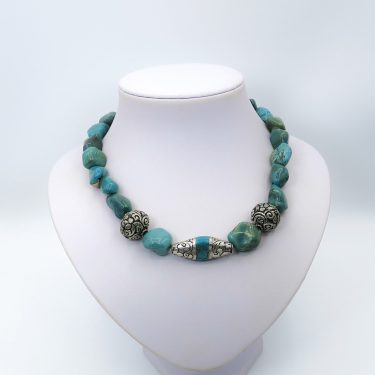
 chunky turquoise necklace€ 190.00
-
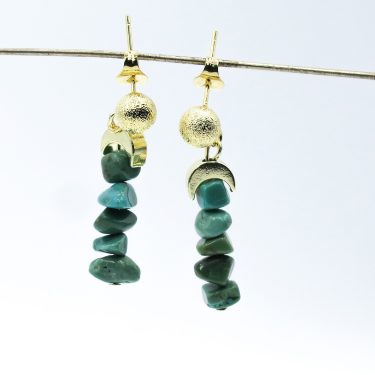
chunky turquoise earrings€ 42.00
Fakes, fraud, and treatment
When demand is high and supply is limited, people create fakes or use treatments to make the mineral more durable. Ancient Egyptians produced imitations using glazed tiles, glass, or enamel, while modern imitations may involve plastics or porcelain. Most are easy to recognize, but high-quality synthetics exist. In 1972, Pierre Gilson invented a synthetic version with uniform color and black spiderweb veining.
It is also easy to imitate by dyeing howlite or magnesite. Knowing how to identify real pieces versus imitations is essential for collectors and jewelry enthusiasts.


Fake or genuine?
Tests can determine whether a piece is authentic. Under a microscope or magnifying glass, natural turquoise shows whitish flecks on a pale blue background. Imitations usually have uniformly dark veining and a granular texture.
The most expensive variety is sky blue. Greenish stones and those with a spiderweb matrix are less costly. Price depends on size, color, and whether the mineral is genuine, untreated except for light waxing or oiling, which enhances its luster.
Dyed imitations, like howlite and magnesite, are less valuable, but when recognized as imitations, the jewelry can still be beautiful, though it is not true turquoise.
FlorenceJewelshop offers stunning pieces made of gemstones, howlite, and magnesite. Each piece is carefully designed to showcase the unique colors, patterns, and textures, allowing wearers to enjoy both authenticity and beauty. Many pieces are inspired by historical designs, blending traditional craftsmanship with modern aesthetics.
Modern uses and care of turquoise
Today, it is widely used in contemporary jewelry. Designers create necklaces, rings, bracelets, and earrings that highlight its natural patterns and vibrant colors. It is also popular in home décor, inlaid in ornamental objects, bowls, and furniture accents.
To care for the stone, avoid prolonged exposure to sunlight, harsh chemicals, or abrasive cleaning. Gentle cleaning with a soft cloth and storing it in a padded container helps maintain its color and luster. Wearing it close to the body allows it to retain energy, according to traditional beliefs.
Fun facts about turquoise
- One of the oldest known gemstones used by humans.
- The blue color was sometimes enhanced with natural mineral oils in ancient times.
- Believed to have calming and protective properties.
- Its name reflects trade history through Turkey, even though it originates in regions like Iran, Egypt, and the southwestern United States.
- Sky-blue varieties are the rarest and most valuable.
- It has been used by many cultures for spiritual, ceremonial, and decorative purposes.
Conclusion
If you love this beautiful mineral, you can choose genuine turquoise, which is expensive, or an imitation. When you know it is an imitation due to budget, you can still enjoy it fully. Either way, it is a treasure to admire.
Gemstones are fascinating and beautiful, with endless stories and fun facts. FlorenceJewelshop has published a free e-book about birthstones and well-known minerals. If you are interested or want to add it to a jewelry gift, just let us know to whom we can send it.

"*" indicates required fields
Hug Florence from FlorenceJewelshop