
 NL
NL
Although pearls are officially the birthstone of June (lucky you, June-born beauties!), I strongly believe the experts should reconsider and make them the birthstone of every month, every week, even every day. Pearls are simply too exceptional to be reserved for just one month. After all, pearls have a magical ability to make every woman look stunning.
Alongside amber and coral, pearls are one of the only organic gems created by living creatures. Despite being formed by animals, they are rightly recognized by gemologists as genuine gemstones. But before you start keeping oysters as pets in hopes of creating your collection, know that it takes a perfect balance of conditions to form a pearl—clean water, ideal temperatures, the right species of mollusk, and a pristine, pesticide-free environment. It’s a miracle of nature that any pearls exist at all!
Let me take you into the fascinating world of pearls. There is so much to discover, and in this blog, you’ll learn about:
- Rare varieties and how pearls are formed
- A rainbow of shapes and sizes, each with its charm
- Exceptional examples and the exciting stories behind them
- Why pearls are the perfect choice for your wedding day
- To knot or not to knot, that is the (pearl) question
- Why now is the time to invest in pearls
Whether you’re here to read the entire post or just want to dive into the chapters that spark your curiosity, you can easily use the table of contents to navigate. But whatever you do, scroll to the end, where you’ll find a link to my free e-book, full of expert tips and pearl styling inspiration. You don’t want to miss it.
Let’s dive in!


Rare species: how they grow
Only a few types of oysters, and in rare cases, certain snails, are capable of producing pearls. Even then, natural pearls are incredibly rare: out of every 15,000 wild oysters capable of forming a pearl, only one will contain one. It begins when a small particle, such as a grain of sand, accidentally enters the oyster. The oyster reacts by coating the irritant with layers of nacre, also known as mother-of-pearl. Over time, this coating becomes the pearl we recognize.
The luster of a pearl depends on how light reflects and refracts through its transparent layers. The more layers there are, and the thinner they are, the finer the shine. Pearls are harvested either by divers or cultivated by pearl farmers. They are often round but can also take on irregular forms. Despite having a hardness of only 2.5 to 5 on the Mohs scale, pearls are surprisingly resilient and difficult to break. They can range in size from the tip of a needle to an extraordinary 24 centimeters (9.45 inches) in diameter, like the famed Pearl of Allah or the Hope Pearl.
Typically, a pearl will lose its nacre layer after about 100 to 105 years. However, archaeologists have discovered intact pearls in Pompeii, dating back to 79 AD. Humans have admired and used pearls for more than 6,000 years. Ancient Egyptians, including Cleopatra, wore them. Pearls have also been found in Mexico dating back to 2500 BC. In India, they were worn as amulets. The Mongols believed that boiling pearls in water gave it the power to strengthen men. In China, pearls were used as medicine, while in Rome, they symbolized luck, power, and wisdom.
The growing supply of pearls
Pearls have long been harvested in the Persian Gulf, but by the 15th and 16th centuries, new sources emerged. Spanish and Portuguese explorers, sent to discover new lands and treasures, returned from the West with gold, gemstones, and pearls. As these luxury goods became more available, their prices dropped.
By the 18th and 19th centuries, pearls were no longer reserved for royalty. Wealthy members of the European bourgeoisie could now afford exquisite strands of pearls. Although still considered precious, pearls were becoming more accessible. A major turning point came in the early 20th century, when Japan and China entered the market with cultured pearls, revolutionizing the industry and making pearls more widely available than ever before.
In all shapes and sizes
Most people are familiar with the classic round pearl or perhaps the slightly elongated rice-shaped variety. But pearls come in many more shapes and colors than commonly seen. Their diversity adds to their charm and uniqueness, making each one a miniature wonder of nature.


Natural Pearls
A natural pearl forms entirely without human intervention. When a foreign particle, such as a grain of sand, accidentally enters the shell, the oyster or mollusk defends itself by coating the irritant with layers of nacre (mother-of-pearl). Over time, this becomes a natural pearl. The Orient Pearl, found in the Persian Gulf, is one of the rarest and most prized types. The term “pearl” is often used for cultured versions, even though true natural pearls are far more uncommon.
Cultured Pearls (Cultivé)
Today, almost all pearls on the market are cultured (also called cultivé). In this process, a small bead or piece of nacre is manually inserted into the oyster or mollusk. Over about two years, the creature forms a pearl around the implant. This method was pioneered by Kokichi Mikimoto of Japan, who patented the technique in 1896. His discovery revolutionized the pearl industry and made beautiful pearls more widely accessible.
Blister and Mabé Pearls
Blister pearls and Mabé pearls are half-round pearls that form differently from traditional ones. Instead of developing inside the body of the mollusk, these pearls grow between the inner shell and the mollusk’s tissue. This results in a dome-shaped pearl with a flat back.
Blister pearls remain attached to the inner shell while they form. Once mature, they can be cut from the shell, usually with a thin layer of mother-of-pearl left behind as a base. The result is a pearl that appears set into a backing of nacre, making it ideal for certain types of jewelry.
In the 19th century, Japanese pearl farmers began cultivating these half-spherical pearls. Cultured versions of blister pearls are called Mabé pearls, named after the oyster species originally used for their production. Mabé pearls are especially valued for their smooth, domed appearance and are often used in earrings, rings, and pendants.

-
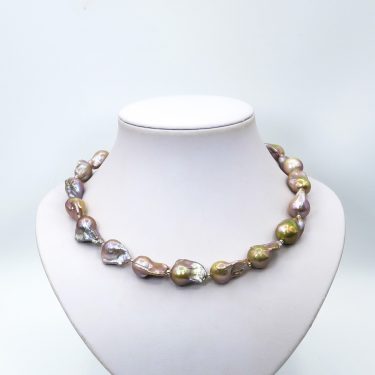
 gold baroque pearl necklace€ 272.00
Keshi Pearls
Keshi pearls are unique because they are made entirely of nacre, which gives them an extraordinary luster and brilliance. The term “Keshi” was first used in Japan to describe pearls that formed without a nucleus.
A Keshi pearl forms when the oyster either rejects the implanted nucleus, but a piece of graft tissue remains, or when a small piece of that tissue detaches during the implantation process. These tissue cells form a pearl sac, and since there’s no core to shape the pearl around, the nacre builds up freely, resulting in irregular and organic shapes. Because they consist only of pure nacre, Keshi pearls are often more radiant than other cultured pearls.
Today, Keshi pearls are becoming rarer. Pearl farmers now closely monitor the oysters, and if the nucleus is lost or rejected, they typically reinsert a new one to ensure a standard cultured pearl develops.
Keshi pearls can grow in both saltwater and freshwater environments. The smallest varieties, typically around 1 mm (0.04 inches), come from the Akoya oyster. Larger Keshi pearls, ranging from 4 to 8 mm (0.15 to 0.30 inches), are found in South Sea and Tahitian oysters.
Their organic shapes and high luster make Keshi pearls a favorite among jewelry designers and collectors who appreciate natural beauty and uniqueness.
-
long pearl necklace€ 60.00
-
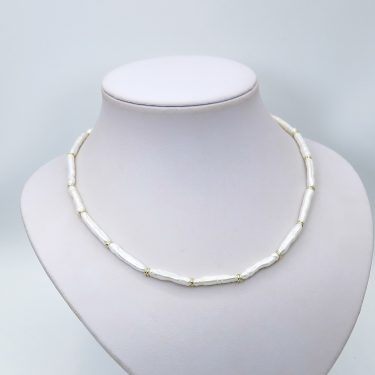
dainty pearl necklace (1 avail.)€ 45.00

Biwa Pearls
Lake Biwa is the largest freshwater lake in Japan and is home to a unique freshwater mussel. A breakthrough in Japanese pearl cultivation occurred in the mid-20th century, when Biwa pearls, cultured without a nucleus, became internationally renowned. These pearls were admired for their soft luster and warm, subtle tones such as pale cream, ochre, and soft gray. However, pearl production in the Hyriopsis schlegelii mussel declined sharply around 1985, primarily due to environmental pollution in the lake.
Freshwater Pearls
Compared to saltwater pearls, freshwater pearls played a more modest role historically. Today, when we speak of freshwater pearls, we usually refer to nuclear-free cultured pearls grown in freshwater environments. Their tradition runs deep—Chinese artifacts dating back to 100 BC show Buddha figurines adorned with freshwater pearls.
China has become the global leader in freshwater pearl production. These pearls come in a wide variety of shapes and rich natural colors like white, cream, pink, mauve, and orange. The development of Chinese freshwater pearl farming has been impressive, and innovation continues to shape the market.
Tahitian Pearls
Named after the island of Tahiti in French Polynesia, Tahitian pearls are cultivated in the Pinctada margaritifera oyster. These pearls are known for their stunning natural shades, silver-gray, blue-black, brown-black, and aubergine. These colors result from environmental factors such as water temperature, minerals, and plankton in the region.
Tahitian pearls are rare and valuable, known for their metallic sheen, smooth surface, and round shape. They take over six years to develop, and out of 2,000 oysters, only about ten yield pearls of gem quality.
Akoya Pearls
Japan has been cultivating Akoya pearls for over a century. Produced by the Pinctada martensii oyster, which inhabits saltwater regions around Japan, Akoya pearls are known for their perfectly round shape, brilliant luster, and rare pink overtones. The oysters are relatively small, about 8 cm (3.15 inches) wide, producing pearls that can reach up to 12 mm (0.47 inches) in diameter. Because of their consistent quality and beauty, Akoya pearls are among the most prized in the world.
Snail Pearls
While pearls are most commonly formed in oysters and mussels, certain snails can also produce pearls. The Strombus gigas (queen conch) snail creates rare conch pearls, usually in shades of soft pink or lavender. These pearls are extremely rare; only one is found in every thousand snails. A flawless, smooth conch pearl is highly valuable; a necklace with matching earrings made of conch pearls once sold at auction for $178,500 (€160,352).
So Many Names, So Many Stories
Pearls are often named after where they are found, the species that produces them, or the environment in which they grow, whether in salt or freshwater. Others are named by shape: button, potato (small and slightly flattened), rice, and more.
In this blog, I want to shine a special spotlight on two pearl types that are quickly gaining popularity…
-
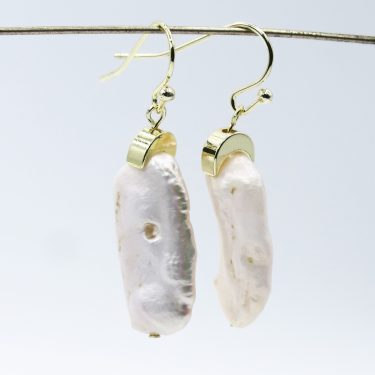
gold Biwa pearl earrings€ 49.00
-
baroque pearl white earrings€ 85.00

Baroque Pearls
Baroque pearls are making a major comeback! On the runways of Paris and Milan, bold, oversized statement jewelry is trending, and pearls are at the heart of it. One of my favorite materials for creating eye-catching necklaces or earrings this season? Baroque pearls.
These so-called “wild pearls” are cultured pearls with a nacre coating that grows around an irregularly shaped core. Because the nucleus isn’t perfectly round, the resulting pearl takes on unique, asymmetrical forms. That’s what gives baroque pearls their one-of-a-kind charm and character.
In many cases, freshwater cultured pearls qualify as baroque because they’re nucleated with mantle tissue instead of a solid bead. However, only the truly irregular ones earn the name “baroque”; the others, such as button, potato, or rice pearls, are named according to their more defined shapes. These are all technically variations of baroque-shaped pearls.
Baroque pearls also occur in saltwater environments. Cultured saltwater baroque pearls are often teardrop-shaped due to their spherical bead nuclei, but the nacre still forms in delightfully unpredictable ways.
So Many Shapes, So Many Stories
In pearl terminology, “baroque” simply refers to any pearl that isn’t perfectly round. These are more common than you might think, and come in all sizes, from minuscule to impressively large.
There are at least 12 commonly recognized types of baroque-shaped pearls, including blister, coin, rice, potato, Keshi, twin, cross, stick, and more. Each has its distinctive features. Of course, as with anything in nature, there are always exceptions. While most baroque pearls are freshwater cultured, saltwater varieties exist too, including rare baroque-shaped Akoya pearls, which are typically known for their perfect roundness.
To keep things simple, in this blog, we’re focusing on the class of pearls that are non-spherical, roughly round or elongated, and marked by charming dips, ridges, and dents on the surface, true baroque beauties.
Are Baroque Pearls Valuable?
They can be. The most valuable baroque pearls come from the South Sea and Tahitian oysters. These pearls take years to form thick nacre layers, and because they’re harvested less frequently, their rarity drives up the price. The longer it takes to cultivate, the more luminous and layered the nacre, and the higher the value.
But value isn’t only about rarity, it’s also about aesthetics and use. While an Akoya baroque pearl might be prized for its unusual shape, another misshapen pearl could be less expensive but breathtaking in the hands of the right designer. A skilled jeweler can transform irregular baroque shapes into showstopping pieces.
Shape also influences price. The most valuable baroque-shaped pearls include Keshi pearls, cross-shaped pearls, and classic baroque pearls. Large pearls typically command higher prices. On the other hand, smaller shapes like rice pearls tend to be less desirable to designers; they’re tricky to work with due to their size and tiny drill holes, and often priced accordingly.
Color matters, too. Baroque pearls in soft whites and pinks are priced moderately, but darker shades, especially those with deep luster and high reflectivity, can be exceptionally rare and expensive. A dark, high-shine baroque pearl is a true treasure.


Baroque Pearls Are Back in Style
When I traveled through Cambodia and Vietnam last January, I found something truly special on the very last day: two stunning strands of baroque pearls. One was a rich, dark gray, almost black, and the other a soft off-white. Under the light, the white pearls glowed with a subtle pink-to-purple sheen, while the dark pearls revealed hints of bronze and brown. Pure magic!
Shell Pearls: The Underdog with a Shine
Shell pearls don’t always get the love they deserve. Some fashion purists turn up their noses at jewelry made with shell pearls. But I say: let them! There’s a time and place for every material, and shell pearls deserve their spot. In this post, I’ll share when it’s better to choose shell pearls, and why they’re more than just a “budget alternative.” They’re beautiful, durable, and in the right design, absolutely stunning.
What Are Shell Pearls?
Shell pearls are man-made pearls crafted from the inner lining (nacre or mother-of-pearl) of oyster shells. The shell is ground into a fine powder, shaped into a bead, and then coated with additional nacre to give it a rich luster. The result? A pearl made of the same material as a natural or freshwater pearl, just formed differently.
While shell pearls are not naturally grown, they aren’t entirely “fake” either. Like lab-created or synthetic pearls, they’re made from the same ingredients as natural ones. The only difference is the process.
Why Choose Shell Pearls?
There are several good reasons to consider shell pearls:
- Budget-friendly beauty: If your budget doesn’t stretch to natural pearls, shell pearls offer the same elegant look at a more accessible price.
- Durability: Perfect for everyday wear, shell pearls are resistant to perfume, sweat, medication, and even mild detergents.
- Consistent quality: Because they’re man-made, you get uniform size, shape, and color, ideal for perfectly balanced designs.
- Customization: Need a specific color or unusual size? Shell pearls come in a wide range of options, not always available with natural pearls.
- Longevity: Natural pearls may fade over time if not cared for, but good-quality shell pearls retain their beauty for decades, maybe even forever.
Shell pearls might not be for everyone, but they have their place, especially in designs that call for consistency, durability, and accessible elegance. Whether you’re looking for a reliable material for your everyday jewelry or just want to play with bold shapes and colors, don’t overlook the charm of shell pearls.
And if you’re lucky enough to stumble across a few rare baroque beauties as I did, snatch them up. Trendy or not, true beauty always finds its place.
Let me know if you’d like to add images, a personal styling tip, or a product highlight at the end!
4o


Choice of Shape and Color
If you love bold statement jewelry with slightly larger pearls, or if you’re looking for a specific color to match your outfit, shell pearls are worth exploring!
Since shell pearls are man-made, every bead can be crafted to perfection. That means your necklace or bracelet will have a consistent size, weight, and color, resulting in a piece that looks harmonious, polished, and simply beautiful. Because they can be produced in nearly any shade, weight, or diameter, your ideal color combo or design is very likely out there. It’s hard not to find the right pearl when the options are nearly endless.
Budget-Friendly Elegance
Natural pearls, especially in larger sizes, can be very expensive, sometimes even out of reach for everyday wear. And while glass pearls might be cheaper, they often lack both the beauty and durability you want in your jewelry.
That’s where shell pearls shine. They offer a high-end look at a far more accessible price point. You get that luxurious glow and beautiful craftsmanship without breaking the bank.
So next time you’re shopping for a pearl necklace, bracelet, or pair of earrings, take a second look at shell pearls. You might just fall in love.
How to Tell What’s What?
Telling a shell pearl from a natural pearl isn’t always easy. But here are a few helpful clues:
- Price: Natural pearls are significantly more expensive, sometimes up to 90% more. If you come across “natural” pearls at a bargain price, be cautious.
- Color: Shell pearls come in every color you can imagine. Real pearls occur in more limited, organic tones, though naturally colored pearls in black, gold, pink, and brown do exist.
- Luster and consistency: Shell pearls often have a flawless surface and mirror-like shine, whereas natural pearls may show tiny irregularities when viewed up close.
A Jewelry Designer’s Secret: Shell Pearls
As a jewelry designer, I love using shell pearls—especially when combining them with harder gemstones. Natural pearls can be delicate and easily scratched by materials like silver, quartz, or lapis. That’s why I’d normally need to knot between each bead for protection. But with shell pearls, this isn’t necessary. They’re tougher, more resilient, and perfect for modern designs where a continuous strand of beads looks better.
Even silver beads or rougher gemstones won’t damage a well-made shell pearl. That’s a huge bonus for durability and design freedom!
Pearls in History: Cleopatra’s Famous Bet
Pearls have fascinated people for centuries. In ancient times, they were rare and valuable, worn only by the elite. That’s why they’re often surrounded by myths, legends, and some jaw-dropping real stories.
One of the most famous involves Cleopatra, the legendary queen of Egypt, and her Roman lover, Marc Antony. As the story goes, first told by the Roman historian Pliny the Elder, Cleopatra boasted that she could host the most expensive dinner in history. Marc Antony took the bet.
When dinner began, he was unimpressed. The food was simple and cheap. But then Cleopatra made her move. She took one of her extravagant pearl earrings, worth millions in Roman currency, and dropped it into a cup of vinegar. After a short wait, she drank the mixture, pearl and all. Just like that, she won the bet.
Fact or Fiction?
Many believed the story was a myth until modern experiments proved it could be possible. Professor Prudence Jones of Montclair State University tested it with a 5-carat pearl and found that it dissolved in vinegar within 24 to 36 hours. The science? Calcium carbonate in the pearl reacts with acetic acid in the vinegar, forming calcium acetate, water, and carbon dioxide.
The ancients may not have had modern chemistry, but they certainly knew their pearls and how to make a statement with them. Therefore, an educated person like Cleopatra may have known this ‘trick’.


Could Cleopatra Dissolve a Pearl So Quickly?
It sounds unlikely, doesn’t it? The historian Pliny the Elder may have condensed the story for dramatic effect, but could such a large pearl dissolve faster than 24–36 hours?
Professor Prudence Jones put the legend to the test. She found that heating the vinegar lowers its water content, increasing the concentration of acetic acid and speeding up the reaction. To further accelerate the process, she crushed the pearl, a technique that drastically increases the surface area exposed to the vinegar.
And the result? In this concentrated, heated solution, the powdered pearl dissolved in just ten minutes.
So it turns out this long-told legend might actually be a historical fact—or at least, scientifically plausible!
The Value of Cleopatra’s Legendary Pearls
Cleopatra didn’t just use any pearl. According to Pliny, the two pearls in her earrings were the largest known pearls in the world at the time. He estimated their worth at an astonishing 60 million sestertii, equivalent to around $29 million today.
These weren’t just accessories; they were symbols of unmatched wealth and power.
Pliny wrote:
“The first place and the topmost rank among all things of price is held by pearls … Their whole value lies in their brilliance, size, roundness, smoothness, and weight … There have been two that were the largest in the whole of history; both were owned by Cleopatra … they had come down to her through the hands of the kings of the East.”
What Happened to the Other Pearl?
Since Cleopatra only used one pearl to win her bet, what became of the other?
According to Pliny, the remaining pearl was cut in half—a dramatic end for such a priceless gem. The two halves were then used to decorate the ears of the statue of Venus in Rome’s Pantheon. A fitting destination for a pearl once worn by a queen, now adorning a goddess.
Pearls for Emperors, Kings, and Pharaohs
Pearls have long been treasured, often exclusively by royalty.
Thousands of years ago, coastal people searching for food occasionally discovered oysters with pearls inside. These rare finds were immediately prized for their beauty. Archaeologists uncovered pearl jewelry in the tomb of a Persian princess dating back to around 400 BC, and ancient Chinese tomb paintings from the Tang Dynasty (circa 700 AD) depict elegant women adorned with pearls in their hair and around their necks.
Because of their rarity, large and high-quality pearls were considered treasures worthy only of emperors and kings. In ancient China, any fine pearl found was automatically claimed by the Emperor. Other monarchs followed suit, declaring pearls as “royal gems,” reserved exclusively for the elite.
What If There Were No Pearls Nearby?
Pearls weren’t native to Rome or Egypt, but that didn’t stop them from reaching Cleopatra’s court.
Arabian traders imported pearls from the Persian Gulf, the epicenter of the ancient pearl trade. They didn’t wait for oysters to wash ashore; they dove for them, collecting oysters directly from the sea. Occasionally, they uncovered extraordinary pearls with unusual colors or unique shapes, pearls fit for royalty.
These rare finds made their way across the desert, carried by camel caravans to the courts of kings and queens. And while everyday people may have admired them from afar, only the elite could afford to own these magnificent royal pearls.


The Pelegrina Pearl
Pearls don’t usually last forever. Their luster typically fades after about 100 years. High-quality natural pearls around 1 cm in diameter already command a steep price. But the Pelegrina pearl is no ordinary pearl. More than 500 years after its discovery, it still retains its original glow and quality, making it one of the most valuable pearls in history. At its last auction, it sold for nearly 11 million dollars.
Throughout the centuries, the Pelegrina has been worn by queens, kings, and other notable figures, appearing in many different settings. Its history is full of twists and turns, and for decades at a time, it seemed to vanish. Let’s take a closer look at this extraordinary pearl and why it has captured the admiration of so many powerful women.
The discovery in South America
The Pelegrina’s story begins in 1513 in the Gulf of Panama. According to legend, a slave discovered the pearl and was granted his freedom in return. It’s a touching tale, though historically inaccurate; slavery hadn’t yet been established in Panama at that time. What we do know is that the pearl eventually made its way to King Philip II of Spain, who ruled over Panama as part of the Spanish Empire.
Weighing nearly 56 carats (or 223.8 grains), the pearl is about the size and shape of a pigeon’s egg. Even back then, its value was estimated at $28,000, a staggering amount for the 16th century. Jewelers believe the real value was far higher, thanks to its extraordinary luster and size. The pearl became part of the Spanish Crown Jewels and was named “La Pelegrina,” meaning “the Pilgrim” or “the Wanderer.” This pearl should not be confused with the more famous “La Peregrina,” though the two are often mixed up due to the similar names.
A royal wedding gift
In 1554, King Philip II presented La Pelegrina to Queen Mary I of England as a wedding gift. She wore it as a pendant on a brooch, a symbol of status and wealth. When Queen Mary died in 1558, the pearl was returned to Spain in a diplomatic gesture of goodwill. It remained part of the Spanish Crown Jewels for the next 250 years.
In 1660, King Philip IV of Spain gave the pearl to his daughter, Maria Theresa, as a wedding present when she married Louis XIV of France. Before handing it over, he wore the pearl himself, mounted on his hat alongside a large table-cut diamond. After Maria Theresa’s death, the pearl likely became part of the French Crown Jewels, though its trail goes cold for a time.
Lost in revolution
The French Revolution in 1792 marked another turning point in the pearl’s journey. Many of the Crown Jewels, possibly including La Pelegrina, were looted by revolutionaries and sold off to foreign buyers. The pearl reappears in Russia, in the hands of the noble Yusupov family. A famous portrait of Zinaida Yusupova shows her wearing it as a pendant on a necklace.
In 1918, during the Russian Revolution, her son Felix Yusupov, best known for his role in the assassination of Rasputin, fled to Paris with a few of the family’s remaining jewels, including the Pelegrina. Life in exile was harsh. With little money to survive, Felix gradually sold off the treasures. In 1953, he parted with the Pelegrina, selling it to a jeweler in Geneva.
From Geneva to Hollywood
After Geneva, the pearl made its way to England and eventually ended up with the Hamilton family. In 1969, Richard Burton purchased the Pelegrina for $37,000 as a Valentine’s Day gift for Elizabeth Taylor. He bought it just in time; Spanish royalty had also been trying to reacquire it.
Taylor asked Cartier to design a necklace to showcase the pearl. The result was a lavish creation adorned with diamonds, rubies, and smaller pearls. She wore it often, including in several of her films.
But the pearl nearly disappeared once again. One day, Elizabeth Taylor noticed the necklace was missing. After searching the house, she discovered her dog happily chewing on something that wasn’t a toy or a bone, but the Pelegrina pearl itself. Fortunately, it survived the incident unscathed.
After Elizabeth Taylor’s death, the pearl was auctioned for nearly 12 million dollars, once again proving its place among the world’s most legendary gems.


You have to take care of your expensive pearls
In 1913, the pearl was cleaned and drilled. Before the cleaning, the weight is 223.8 grains / 11.2 grams. After the cleaning, there are only 203,84 grains left. Although the Pelegrina remains the largest pear-shaped pearl in the world, about 20 grains are gone. Part of the explanation can be the drilling, but that cannot be that much. There might be another cause…
In the time of Louis XIV, there were a lot of parties for the nobility. And taking a bath regularly was not a custom in those days. Everybody wears a wig, in the house and outside. To avoid the fleas coming into the wigs and your body odor getting too strong, people perfume and powder their wigs and use perfume on their clothing, body… well, about everywhere. Combine these facts with using candles at parties, and you can imagine the grease that sticks to the gemstones and pearls. That grease might even weigh about 20 grains.
Are there more exceptional examples?
Yes, there are, as the Pearl of Allah or the Pearl of Laozi. This one is about 24 cm / 9.45 inches big and weighs 6.4 kilos / 226 ounces. This is the biggest one in the world: it’s white but without any brilliance. A Filipino diver found this giant in the Sea of Palawan in the Philippines. This Tridacna Pearl is the product of a Baptismal Font Shell, i.e., Tridacna gigas. That is a large oyster, and the animal has a foreign object in the shell. The maximum age of the baptismal font shell is probably around a hundred years.
The ‘pearl of Allah’ looks like a head with a turban, and that turban has been associated with Mohammed and Allah. In 1966, a legend arose that in the gem there would be an amulet (already for thousands of years) with a verse from the Chinese philosopher Laozi. It was placed every time in a bigger shell so that it could grow. At the moment, an American family owns the Pearl, and now and then the gem is exhibited. The estimated value in 2007 was about 93 million dollars / € 83 million.
Exceptional 20th-century stories
In August 2015, a shell was found in the Oosterschelde (estuary between Belgium and the Netherlands) with 21 pearls. Normally, you can find at most 2 copies in a shell like that. The fisherman sold it to a fish store in the south of the Netherlands, and there they discovered an exceptional amount in only one shell. The shell was auctioned in the Hague/the Netherlands, for € 2600 / $ 2902.
Wear pearls on your wedding day!
They are also called ‘wedding tears’, and in one culture, wearing pearls on your wedding day brings luck, while in another culture claims that wearing them on your wedding day brings bad luck. That’s not very helpful when you want to wear them at your wedding. The superstitious women and the ones who don’t believe in those stories…
Pearls on your wedding day bring luck
Let us start with all the myths that tell you to wear them on your wedding day. According to the Greeks, the white beauties represent the tears of joy from the goddess of love, Aphrodite. They will give you protection, make friendships stronger, and stand for purity, health, wealth, and modesty. These symbols stand for a great marriage, and therefore, you should wear them on your wedding day.
- The legend that claims that they are also called ‘wedding tears’ mentions the fact that brides tend to cry a little at the ceremony. And a little cry or tears will bring you luck. That is also true for wearing pearls on your wedding day.
- In China, people thought that they were the brains of dragons (and they would bring you luck), and the people in India thought that they came from the clouds. And the clouds represented a life without problems, so luck. So wear those pearls on your wedding day!
- In the Middle Ages in Europe, soldiers carried one with them under their harnesses. It kept them safe from injury and worse (they thought). And it helps a lot when they receive that pearl from a woman.
- Pearls fit perfectly in the tradition of ‘something old, something new, something borrowed, something blue. Especially when you get your string from your mother, that string has a great emotional value.


Do pearls on your wedding day bring bad luck?
According to other sources, you should avoid wearing them at your wedding. They look like tears, and tears bring back luck. Then the old mother-in-law story: when you get your wedding pearls from your mother-in-law, be careful, they will bring tears!
To be honest. The reasons above are the only ones I could find not to wear on your wedding day.
2 reasons to wear them on your wedding day!
- All pearls are different; there are no two (real, natural) alike. You are a unique woman, and for your groom, you are a unique miracle, called the woman. So you deserve to wear pearls on your wedding day, on the most important day of your life.
- The color matches perfectly with a bride’s gown. They add to the beauty of the bride and her dress. Not too much, just perfect. Little ones on the material enlighten a lot of gowns and a necklace and/or earrings made of real pearls look awesome.
Knot or not?
Is it a great idea to knot your pearls? Or rather not? When I was a young girl, I helped my father in his jewelry shop by picking up the pearls from the broken strings. Most of the time, they are expensive, and when the string breaks, the beads roll everywhere, in small places, where only very small fingers and short people can reach them. So when you asked me at that time, ‘Is it wise to know your pearls?’ I would say YES YES!!!
My grandmother always told me that you should knot your pearls. Period. I am from a jewelry family, and my grandmother knows her business. But there are old Mikimoto pearls that are not knotted and in perfect shape.
Is it a tradition to knot? Or are there modern solutions to keep your pearls safe and healthy? Why should you knot? It might be the terrible 1 million dollar question, certainly when we are talking about very expensive pearls.
Why knot in the first place?
Let us start with the traditional way of keeping your pearls in perfect shape. To avoid losing them jewelers knot their expensive strings, and you should knot too. When the cord breaks, you only lose one of two pearls and not the whole string. That is, if you notice losing them, otherwise, the whole string is gone.
That is what happened in the father’s jewelry shop all the time. People came with unknotted necklaces and asked my father to knot them. Then the client showed him why it was necessary, and there the pearls flew all over the place.
Besides, the reason for preventing losing the knot is a kind of buffer, so that the beads don’t rub against each other. The nacre is precious and soft, and when they hit each other all the time, the nacre comes off. A knot between each pearl prevents this. So… knot!
Knotting: disadvantages
- The pearls are beaded on a silk cord, and there are knots placed between them. After 4 to 5 years, the cord stretches and becomes thinner. You have to ask a jeweler to restring the necklace. They charge per knot! And it is expensive to knot them with a professional. When the cord is getting dark, you know that you need to restring. And when there is a little space between the knot and the bead due to the stretching of the cord, it is time to watch your pearls.
- When you have small ones, and the string is knotted, the knots look larger than the pearls. And the size of the knot is not always the same. This is not so beautiful (it looks more like a rosary than a pearl necklace), and you can decide not to knot, especially when they are smaller.
- The idea that the knot will separate and protect the beads from rubbing is a bit old-fashioned. There are very small black or white rubber bands on the market; you bead between them to keep them apart. You bead on a strong string, use the small bands, and you don’t have to restring them, and it’s safe.
- The knots disrupt the ‘flow’ or the shape of the necklace. With a normal, strong string and rubber bands, the necklace falls smoothly around your neck.
- Knotting, especially when they are smaller or the strand is long, can cost you a fortune. Not only because you have to restring the strand every few years (safety reasons, because the silk thread wears out and gets longer), but also because they will charge by the knot. At the moment, jewelers ask €12,50 ($14,40) for adding the clasp and then €0,85 per pearl ($1)
On what occasions do you knot your pearls?
Of course, I cannot tell you to knot or not to knot. It is a matter of preference and style. But you find some ‘rules’ here:
- Natural large pearls (more than 1 cm) are expensive and heavy. When you choose to string them on a silk cord that can stretch and break, the advice is to knot or use a strong thread with the rubber bands.
- Multistrand pearl necklaces are difficult to make because the strings have to hang perfectly below each other. When there are knots between the beads, it is very difficult to make it perfect because every knot is just a tiny little bit different in size, and the space between the knot and the pearl may differ too. So don’t knot when you have a multi-strand pearl necklace.


and more tips… about when to know these beauties
- A single-strand natural pearl necklace can be knotted, but it looks great without the knots, too. It depends on the length of the knot whether knotting is a wise thing to do. When chokers are shorter than 16 inches, it is safe without the knots, and it looks more beautiful. But when the necklace is longer than 18 inches, the advice is to knot your string or use a strong thread with rubber bands.
- Long natural pearl necklaces must be knotted. They are heavy, and you can wrap them a few times around your neck as a multi-strand necklace or shorten them with a knot. The silk cord endures a lot of tension, so knot it to be on the safe side.
Honestly, I prefer a ‘not knotted’ necklace because it drops down beautifully, and I don’t like the knots, which look too large sometimes. I string my pearls on a strong thread, and if necessary, I use rubber bands.
Buy a beautiful string now!
After diamonds, pearls are a girl’s best friend. They look great on young girls, the young-at-heart girls, and the more sophisticated ladies. And the good thing is that there is a string in every quality and price range. There are 2 reasons why you’d better buy your string now! especially when you want high-quality natural pearls. Due to pollution, high demand, and lower supply, and to the old-fashioned, inefficient harvesting methods, the natural pearl became rarer and very expensive. My tip: buy your natural string now!
Pearl prices go up
Until the beginning of the 20th century, divers had to go down in the sea until they reached a depth of about 35 meters/ 100 feet to get to the oysters. It was dangerous, and the results were poor. When they gathered about a ton of oysters, the average of finding a decent pearl was about 3 or 4 good-quality pearls. That’s hard work. The freshwater mollusks in the shallow waters and rivers were easier to harvest.
You find natural pearls nowadays only in Bahrain and Australia. They harvest the ones that are ‘made’ completely by nature. These become very rare and very expensive. When you know that a string only lasts between 60 and 100 years, you can imagine that antique pearl jewelry is not only popular but also very expensive.
The harvested natural pearls diminish
Oysters need extremely pure water to grow the best high-quality pearls. The environment for the natural and cultured types to grow becomes less and less. Due to too many plastic particles in the oceans, inadequate sewage systems pollute the coasts. And industries that get rid of their waste and chemicals in the water. A sad example is Lake Biwa in Japan, where special mollusks live that produce beautiful luster pearls. Due to pollution, there is hardly any harvesting of Biwa pearls anymore in Lake Biwa.
Buy a string before they are gone
01. Buy your high-quality string now before they are not available. A natural string is hard to find, and even a cultivé string of pearls of high quality is not easy to get.
02. A string of pearls is getting very popular at the moment. And when the demand is high, the price goes up. So, another reason to buy your string now. Let me tell you what the prices are at the moment:
An about-perfect pearl gets the predicate AAA. That may cost about €100.000 ($113.100). The value is determined by 7 factors:
- Luster
This is the most important factor for beauty. If you want to purchase them, luster is one of the most important features to look at. You recognize a high luster when you can see sharp reflections. The better the reflection, the higher the luster, and the higher the value.
Saltwater pearls have a higher luster because the layers of the mother-of-pearl are thinner. So, more layers are needed to form the pearl, and more layers of mother-of-pearl give a higher luster.


- Size
The larger the pearl, the rarer it is. Freshwater pearls produce thicker layers of nacre and grow faster. The saltwater variety takes more time to grow, due to the thinner layers, and therefore is more expensive.
The size of a pearl is indicated in millimeters in diameter. The size of a pearl can vary from 4 mm (like rice pearls) to the very rare 18mm to 22 mm South Sea pearls.
- Shape
The shape is important for the value. The rounder, the more valuable. The ultimate goal is a perfectly round one, although there are many other highly prized shapes as well, like the Baroque or the drop pearl. So when purchasing them, go for the shape that you like best.
- Surface
Pearls are natural products, and you cannot force nature. So most of them show one or more irregularities, like pitting, discolorations, or growth rings. Fewer irregularities mean a higher price for them, although it is not the only thing to look at.
- Color
The color of the pearl is determined by the color of the inside of the shell. It is remarkable, but the color does not affect the price much, except when a certain color gets more popular than the other one. Traditionally, ivory, white, and dark, and the almost black variety are today’s favorites.
- Natural or cultured
Natural pearls are found in mollusks in the sea, and they are naturally found, without the intervention of man. And cultured ones are grown on a pearl farm. About 99% of all pearls traded worldwide are cultured ones.
If you want a necklace with pearls that are more or less of an even size, you have to rely on cultured or cultivated types. In every 15.000 oysters, one pearl grows, and you never know the size.
- Type
Rare types are more valuable. South Sea pearls are the most expensive variety, and after these, the Tahiti and the Akoya pearls. Freshwater pearls are the cheapest type.
A South Sea pearl necklace may cost much more than €100.000 ($113.100), and a high-quality freshwater pearl necklace is about a few thousand euros.
When you take care of your string, it can last a lifetime and a bit longer (60-100 years). Keep your string in a soft cloth, keep it away from dust, and check the string regularly.


Which lady should have pearls in her jewelry box?
That is a very simple question: every lady from 18 to 118 years old should have a pearl necklace, earrings, or a bracelet. There are some stories that a bride should not wear a strand of pearls because they represent tears. So happy, this is only a story, because what is more beautiful than a bride with a white wedding dress and a delicate pearl necklace with matching earrings?
As always, there is one but… or maybe two things you should know about wearing these beauties. First, you have to consider your features. So don’t wear a tiny one-strand pearl necklace when you are tall or wide-figured, but do when you are small. For detailed advice, pls have a look at the other blogs from FlorenceJewelshop. Second, a pearl is delicate, and the shine can vanish. So, put your jewelry on when you don’t wear it with a soft cloth and don’t use perfume or hairspray after you have put your necklace or earrings on.
Show off as the royals do.
- You can organize an exclusive dinner party as Cleopatra did, crush a pearl in your wine, and impress or
- Choosing a high-quality natural copy for your piece of jewelry and
- Keep your dress simple so that the pearls look more beautiful on you.
- Combine them with precious gemstones for a ‘rich’ look and feel
- Or follow the trend of having pearl eye makeup.
Logically, a pearl is called a gem or even a gemstone. They are so ingeniously formed by such ‘clever’ animals, who give us such beautiful pieces of nature to make the most beautiful jewelry. For every budget and taste, there is a pearl. FlorenceJewelshop has made handmade, unique (no duplicates), and exclusive necklaces, earrings, and bracelets made of pearls. Just have a look.
I wrote a great and free e-book about pearls. You will find a lot of information there. It’s free, and just let me know where I can send it to.

"*" indicates required fields
Florence from FlorenceJewelshop