
 NL
NL
In 2011, archeologists found under the Pyramid of the Sun in Teotihuacan (Mexico) a 2000-year-old green mask, made of serpentine. One way or another, this fantastic news appeared on Twitter last year. And now quite a few people ask themselves… nice a mask… serpentine… what is ‘serpentine’?
Don’t worry, I will explain and show you this stunning gemstone, which has so many possibilities for using it, that you might say #1 all-around gemstone.

Let’s talk about that old mask first!
The Pyramid of the Sun in Teotihuacan was built around 50 AD, but archeologists think that it was built on the ruins of another Pyramid or temple. And those builders are unknown; they vanished without a trace (until now) when the Aztecs took over.
At the base, in a tunnel, deep under the ground, this stunning green mask, made of serpentine, is found, together with 11 ceremonial clay pots dedicated to the rain god Tlaloc. And some animal bones, some pieces of obsidian, and three human statues were also made of serpentine.
But the mask was most intriguing. It is very delicately and in detail carved so that it looks like a portrait. It is the first mask (and until now the only one) of this type that is found in a ritual context in Teotihuacan.
And it is safe to say that even 2000 years ago, people knew the gemstone serpentine and used it for carving statues and at least one mask.

Mexico is not the only place…
Although the green mask is rather old, it is not the oldest proof of using serpentine. In Ancient Times, the Sumerians, Assyrians, Persians, and Egyptians made seals of serpentine.
When you polish this stone, it gets a greasy and oily surface, which is ideal for seals. The wax or the clay could not stick to the surface and you could use the seal many times without cleaning it all the time.
The cylindrical seal was used from about 3500 BC in Mesopotamia. And from that time on, there is proof that people knew about the serpentine and its good features.
People in those days loved its luster, and it was used to make jewelry, statues, and household items. Not only because this gemstone was so beautiful, but also because it was rather soft (3-6 on Moh’s scale) and therefore easy to carve.
The word goes that serpentine is protection against snakebites and other poisons and could act as a defense against evil spirits. Pendants made of this greenish stone were popular!.
The Romans came up with the name
Also, the Roman sorcerers were sure about the great feature of the gemstone of protecting against snake bites. And they called the serpentine ‘serpentines’ or ‘stone snake’. And all around the world, civilizations thought the same and admired the gem for it.

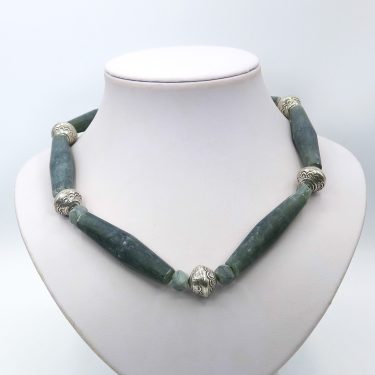
green statement necklace
€ 143.00
-
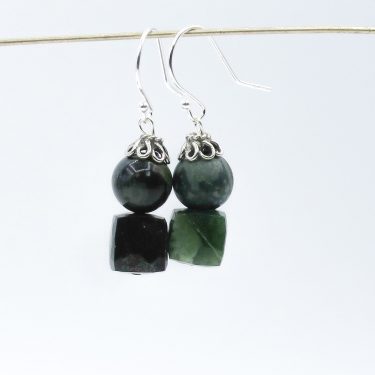
green gem earrings€ 39.00
India is the place to go
The city of Bhera in Punjab (India) was famous for producing serpentine carvings, like mugs, statues, handles, and sword decorations. They imported it from Afghanistan, and their name for it was ‘Sang-i-Yashm’, but the British called it ‘fake jade’. And they have a point. Quite a few statues are sold as jade but actually are made of serpentine. The sellers have all kinds of nice names for it, like New Jade, Styrian Jade, or Suzhou Jade.
All-round gemstone
As stated, serpentine is a rather soft gemstone and is perfect for making jewelry. That is, if you stick to necklaces or earrings. For rings and bracelets, the gemstone is not strong enough, and the jewelry can easily be damaged. But serpentine is used for much more than only jewelry.
An architectural stone
For thousands of years, serpentine has been used for interior decoration, like wall tiles, columns, etc. The variety in colors, mostly green, the great patterns of the stone, the easy handling, and the great luster after polishing made this stone popular. It is softer than granite but harder than marble. In the first half of the 1900s, this material was very popular in the United States of America.
In architecture, serpentine is valued for its deep green color. A well-known example is Verde Antico stone used in high-end buildings.
Carved stone statues
Serpentine and especially some varieties (the softer ones) are excellent carving materials. Ancient civilizations already found that out long ago. You can make sculptures from a few centimeters to several meters high and in all kinds of shapes.
The soft stone and the possibility to polish it after carving give a beautiful result.
-
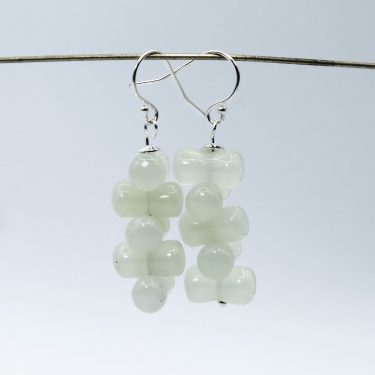
green serpentine earrings€ 46.00
-
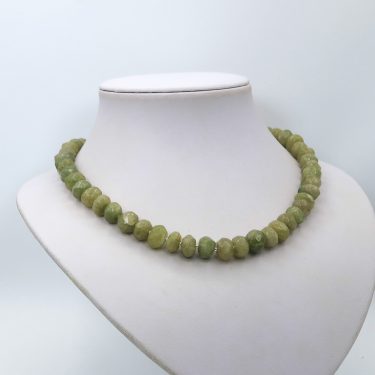
faceted serpentine necklace€ 126.00
Industrial stone
Serpentine, in general, is a rather common stone and is abundantly found in many places. Especially the chrysotile variety is/was used as railway ballast, road surfaces, or building material. But the chrysotile serpentine contains asbestos, which can cause severe lung problems.
Although asbestos is only a menace when you inhale the asbestos dust, at the moment, a lot of countries have programs to get asbestos out of houses and the environment. Although the feature to stop a fire is perfect, people don’t want it anymore.
That is also the reason that from the second half of the 1900s, the popularity of serpentine as a building material diminished. Since 1965, this gemstone has been the official stone of California (USA), but due to asbestos problems, the official status as the state stone was revoked.
Note of advice: Polished serpentine jewelry is safe; the asbestos hazard comes from inhaling powdered fibrous chrysotile, not from wearing intact stones.
What is serpentine actually?
You may think that this gemstone is one single gem. But it is not! It is a group of 20 members or minerals that are very hard to distinguish. They are created by a metamorphic process, which you see at low temperatures when heat and water come together and oxidize rocks.
The minerals are made of tiny sheets of silicon, and they are held loosely together. The weak connection between the sheets gives the gem a greasy or scaly look and a slippery feel like a snakeskin.
In the serpentine rock, you find small amounts of manganese, cobalt, nickel, and chromium, and these elements are the cause of the different colors of the gemstone. The stone can be from apple green to black and every color in between, but the most common is olive green.
The gem is opaque, and you can see some veins in the stone. It is often mottled with light and dark-colored areas. The surface has an oily appearance and looks a bit soapy. The stone is most of the time fine-grained and compact, but sometimes more granular, platy, or fibrous.
There are about 20 different varieties, but not all of them are suited for making jewelry. The best jewelry variety is antigorite and has no asbestos, unlike the chrysotile variety.
Other names are lizardite, atlantisite, greenstone, bowenite, and Willimansite. The general name ‘serpentine’ was given by Georgius Agricola in 1564 (not the Roman Emperor). He derived the name from the Latin word ‘serpens’, meaning snake, because of the snakeskin look of the gemstone.


Where to find this gemstone?
That is the easiest answer in this blog about serpentine. And the answer is in about every part of the world. From South Africa and Madagascar to Australia. From Peru to Austria, France, and the United Kingdom in Europe. But also in the United States of America and quite a few more places.
20 Different types of serpentine
Yes, there are about 20 variations of this gemstone. That is why I stated that this is more or less an all-around gem, also considering the different possibilities for using this stone. But don’t worry, I will only discuss the most important varieties for making jewelry with you.
Antigonite
This variety is formed deep in the earth’s crust (at 60 kilometers or 37 miles or so) and is stable at the highest temperatures. Ideal for your jewelry. It contains 13% of water, and scientists think that through antigorite, water is transported to great depths.
Antigonite has most of the time a light to darker green color, but can be yellowish, gray, brown, or black too. The hardness is 3.5-4 on Moh’s scale, so rather soft, and this type is not easy to cleave or cut.
It is named after the first location it is found, Valle Antigorio, between Switzerland and Italy. But is also found on every continent, even in Antarctica. When it is from Pakistan the color is yellowish-green and almost transparent.
Bowenite
This is a variety of antigonite (can you still follow me?), which is harder (5.5 on Moh’s scale) and has a light to apple green color. In the United States, mottled with cloudy white spots and somewhat darker veins. This variety is excellent for making jewelry.
The Bowenite is named after G.T. Bowen, who studied this gemstone, but it is also called ‘retinalite’ (yellow color) or ‘tangiwai’ in New Zealand. This Mr. Bowen thought that Bowenite was jade!!! So that you know what to look for in those countries.
It is the state gemstone of Rhode Island in the United States, and you can see it there more frequently in jewelry stores. In 1967, Mrs. Lady Bird Johnson received the “Our Mineral Heritage Brooch’ with a Bowenite cabochon in it.
In different countries, the Bowenite has different colors: in Afghanistan, it is green, the Bowenite from China is yellowish-green, in New Zealand, dark bluish-green, and in South Africa, it is banded in green shades.


Williamsite
In the United States, they have a local variety of the Antigonite, called Williamsite. It is oily green with black crystals of chromite or magnetite included. That magnetite can be so strong that you can move the stone with a magnet.
It looks a bit like jade and is apple green with darker crystals of chromite and brucite. You find this variety in Maryland and Pennsylvania. The best quality is mined in Rock Springs, Maryland, and is deep green.
The Williamsite gemstone is named after L.W. Williams, who first found this gem and recognized it as a separate gemstone (variety)
Lizardite
The most common faceted serpentine is the lizardite, another variety of antigonite. In different countries, you find different colors of lizardite. In Kashmir and Scotland, they are gray or green; in the United Kingdom, you will find various colors and all veined.
Jade or serpentine or… jade?
As mentioned above, the serpentine is frequently mixed up with jade by accident or on purpose. Jade is more expensive, so it makes it worthwhile to try to sell serpentine for jade.
But… jadeite and nephrite both are heavier and tougher. They can stand blows better; even a blow with the diamond will not damage the real jade, but certainly crack the serpentine.
A lot of the serpentines on the market are treated with resin to make the gem stronger. Nothing wrong with that as long as you know. But they can also be dyed green or jade color and sold as jade. Or dyed in a completely different color. For instance, I have purple sugilite (as it is sold for), which is dyed serpentine. I noticed it because it was so much heavier than I expected.
Another way of ‘fraud’ is using the serpentine together with jade in a so-called assembled stone. This means that the top is jade and the rest is another gemstone, most of the time, much cheaper than the one on top. You can hardly check this, so buy your gemstones from known jewelers.
How to take care of serpentine?
Clean your beautiful gemstone with a soft brush or cloth, a mild detergent, and some hand-warm water. Just avoid steam or ultrasonic cleaning.
Healing properties
The serpentine has quite a few good features that could help improve your health. No guarantees, but you can try all the same.
It could resolve problems with diabetes and restore the right balance of magnesium and calcium in your body. It is said that it can cure heart and lung problems. This gem can relieve cramps and menstrual pains and help to renew cells. And… protects against parasite infections.
News about the serpentine
Recent interest in serpentine comes from several fields. Scientists study it for its potential to absorb carbon dioxide. This could help reduce CO2 in the atmosphere and support climate solutions.
Serpentine also plays an important role in Earth’s geology. It influences processes in the Earth’s mantle. It can affect earthquakes by reducing friction along fault lines. Researchers also link it to conditions that supported early life on Earth.
Now you know about everything, whether you want to buy serpentine jewelry or not. And if you want to, you know what to buy and to look for. Just to see how beautiful serpentine jewelry can be, have a look atFlorenceJewelshop.
FlorenceJewelshop has published a PDF with a lot more information about birthstones and other gemstones, for those interested. It is free of charge. Just let me know where to send it to.

"*" indicates required fields
Florence from FlorenceJewelshop