
 NL
NL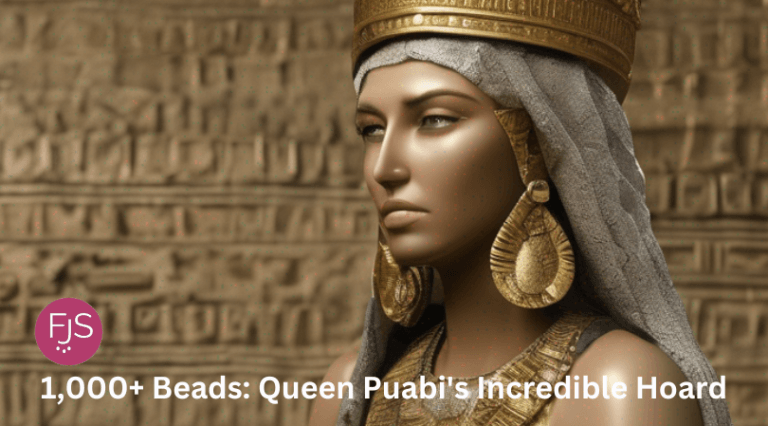
A Queen and Her Jewels
Ever since studying history, I’ve been fascinated by strong female leaders. Throughout the centuries, these women were not only wise and powerful, they were rare. Sadly, even today, true female leadership remains extraordinary.
Last year, during a visit to the British Museum in London, I encountered the story and the breathtaking jewelry- of Queen Puabi. She was a powerful queen of the Sumerian Empire in ancient Mesopotamia, and her tomb, remarkably preserved, was filled with stunning treasures.
Today, I’d love to introduce you to Queen Puabi and the incredible jewelry that tells her story.


Mesopotamia
Queen Puabi: A Glimpse into Ancient Mesopotamia
Queen Puabi lived around 2450 BCE in the city of Ur, located in present-day Iraq. This region, historically known as Mesopotamia, meaning “land between the rivers”, was nestled between the Tigris and Euphrates rivers. These waterways were vital, much like the Nile was to Egypt, providing fertile lands through annual flooding and supporting a thriving agricultural society.
Southern Mesopotamia, often referred to as ancient Babylonia, was divided into regions, with Sumer in the south. It was in Sumer that Queen Puabi held her esteemed position. Her tomb, discovered in the Royal Cemetery at Ur, offers a remarkable insight into the wealth and artistry of the Sumerian civilization. Among the treasures found were intricate gold jewelry, elaborate headdresses, and finely crafted musical instruments, all testifying to the sophistication of the time.
Queen Puabi’s burial site was unique, not only for its opulence but also for its preservation. Unlike many tombs of the era, hers remained untouched by looters, allowing archaeologists to study the artifacts in their original context. This discovery has provided invaluable information about Sumerian culture, social structures, and the prominent role that women like Puabi played in their society.
If you’re interested in exploring more about Queen Puabi’s artifacts, the British Museum and the Penn Museum house many of these treasures, offering a tangible connection to this fascinating period in history.
The Discovery of Queen Puabi
In December 1927, archaeologist Dr. Charles Leonard Woolley made a remarkable discovery in the Royal Cemetery of Ur: an intact grave belonging to a woman who had reached the age of about 40. This woman was none other than Queen Puabi.
The grave was filled with exquisite jewelry and other luxurious items, all believed to be necessary for the afterlife of someone of great importance. Among the treasures, Woolley found a cylinder seal placed on the woman’s chest.
The seal bore the title eresh, meaning “queen” or “priestess” in the Sumerian language. Unusually, there was no mention of a husband or father, no “wife of” or “daughter of”, which was highly uncommon in a society where women’s status was typically defined by their male relatives. This absence suggested that Puabi held a position of power in her own right.
Today, it is believed that Queen Puabi was the sole ruler of Ur, a queen from the First Dynasty of Ur and a figure of significant authority. Through her seal, not only was her title revealed, but also her name: Puabi, which translates to “word of my father” or “orchard of my father.”


What Queen Puabi’s Grave Reveals
Before the discovery of her grave, very little was known about Queen Puabi. We do not know how she came to power or what her reign meant for her country. To piece together her story, we must rely on the treasures and evidence found in her tomb.
The jewelry uncovered in her grave offers valuable insights into her status, the techniques craftsmen mastered at the time, and the ideals of beauty in ancient Sumerian society.
However, there is even more that continues to astonish us today.
In those times, it was customary for the personal servants of important figures to be buried alongside their masters or mistresses. In Queen Puabi’s burial chamber, three individuals were found with her. Nearby, another group of twenty-one people was discovered.
In a larger burial pit close to her grave, Dr. Woolley found seventy-four additional attendants, six men and sixty-eight women, all adorned with ornaments made of gold, silver, and lapis lazuli. One woman, noticeably, wore more jewelry than the others, suggesting she may have held a higher position among the servants.
These attendants were buried together with animals, including a horse, lions, and a cart. It is believed they either poisoned themselves or were poisoned by others to accompany their mistress into the afterlife. In some cases, there is evidence that the cause of death was more violent, with signs of blunt force trauma to the head, possibly inflicted with a hammer-like tool.
The Tomb of Queen Puabi
My father used to comfort me whenever I felt discouraged about my (short) height by saying, “Florence, it is about quality, not quantity.” He could have said the same to Queen Puabi. She was only 1.22 meters tall, about four feet, and was found resting on a beautifully decorated bed in her tomb.
To ensure she looked her best in the afterlife, thousands of gemstone beads and pendants were placed over her. Many of the pendants were shaped like dates, symbolizing the kingdom, and apples, which in Mesopotamia stood for fertility, happiness, and a long life.
There were also vessels filled with gold, silver, and precious stones, all meant to accompany her beyond this world. Yet among all these treasures, the most striking and unforgettable piece was Queen Puabi’s magnificent headdress.


The headdress or diadem of Queen Puabi
The headdress was both heavy and dazzling. It contained 2.21 kilos of gold and was made up of four wreaths, crafted from twenty gold poplar and willow leaves. These wreaths were further adorned with beads and pendants of gold, carnelian, and lapis lazuli.
Twelve meters of gold ribbon were used to divide Queen Puabi’s hair into layers, and the entire arrangement was supported at the back by a large gold comb decorated with seven gold flowers.
It is not certain whether the way the headdress was arranged on Queen Puabi’s hair truly reflected how it had been worn during her life. It is more likely that Dr. Woolley’s wife used the jewelry and materials found in the tomb to create a striking design, possibly influenced by the flapper fashion trends of the 1930s.
Around her neck, Queen Puabi wore a choker featuring a rosette at its center. A beaded belt with a border of gold discs was placed around her hips.
Queen Puabi’s other jewellery
In addition to the vessels, thousands of beads, and the impressive headdress, Queen Puabi was adorned with a wealth of jewelry. She wore multiple necklaces, chokers, and large earrings shaped like golden crescent moons. Her upper body was draped in strings of precious stone beads, along with gold and silver beads. Each of her fingers bore a ring. Nearby, on a table close to her bed, lay a diadem made from thousands of small lapis lazuli beads, with two gold pendants shaped like plants and animals.
Dr. Woolley also uncovered a stunning harp with a bearded bull’s head, inlaid with gold and lapis lazuli. The tomb contained gold tableware, cylindrical beads of gold, carnelian, and lapis lazuli materials that were used to create necklaces and belts in that era. But the discoveries didn’t stop there: the tomb also revealed a chariot adorned with silver lion heads, an abundance of silver, lapis lazuli stones, gold rings, and bracelets. A belt composed of gold rings, carnelian, and lapis lazuli completed the collection, along with various other smaller pieces of jewelry.


The shroud of Queen Puabi
The term “shroud” should not be taken too literally. Queen Puabi’s upper body was decorated with a type of blouse, featuring a round neck that fell loosely to her hips, made from strings of beads.
These beads came from a variety of regions, not just Mesopotamia, highlighting the vast network of trade connections at the time.
The long orange carnelian beads likely originated from the Indus region (modern-day India) or were crafted by Indian artisans who eventually made their way to Mesopotamia. The technique used to drill holes in the beads was unique to the Indus Valley, as were the specialized Ernestine drills used in their creation. These tools either came from the Indus region or were brought to Mesopotamia by Indian craftsmen.
The dark blue lapis lazuli beads were probably sourced from Afghanistan, while the banded agates found in the tomb were not native to Mesopotamia. These stones were either imported as rough materials or already crafted into beads.
The materials used in the “shroud” were all imported, a clear indication of extensive trade contacts and the considerable wealth necessary to acquire such valuable resources.


The beads
Most of the long carnelian beads were found on the bodies of the attendants, who were buried near Queen Puabi’s tomb. These women wore golden flower-shaped headpieces, similar to those seen on unique terracotta statues discovered in the Indus Valley, near Harappa (a city now located in Pakistan). It is believed that traders, craftsmen, and likely these attendants came from the Indus Valley and eventually made their way to Mesopotamia.
Returning to the carnelian beads, one was found on the headpiece of a man buried in the same tomb as Queen Puabi. This particular bead was 61.54 cm long and was drilled with an Ernestine drill, a tool characteristic of the Indus Valley.
The shape of this bead is not typical of those from the Indus Valley, suggesting it likely originated from Gujarat, located north of Mumbai on the Indian coast. The production of such beads was highly controlled, and only bead makers from the Indus Valley who had moved to Mesopotamia would have been able to craft them.
This discovery provides clear evidence of an established and thriving trade system that brought carnelian beads and other valuable goods from the Indus Valley to Mesopotamia. It’s fascinating how the discovery of these beads in jewelry offers a glimpse into the complex trading networks and societal structures of that era.


Excavation of the tomb of Queen Puabi
Between 1922 and 1934, the British archaeologist Dr. Leonard Woolley conducted excavations of around 1,800 tombs in the Royal Cemetery of Ur. The project was funded by the British Museum in London and the University of Pennsylvania Museum of Archaeology and Anthropology.
The discovery of Queen Puabi’s tomb made headlines worldwide, as it was remarkably intact and contained an abundance of treasures, most notably jewelry. This jewelry provides valuable insights into the era of Queen Puabi:
It reveals that in 2450 BC, there was a distinct “fashion” in Mesopotamia, with a preference for gold combined with blue lapis lazuli and orange carnelian. It also demonstrates that jewelry-making techniques at the time were highly advanced.
The materials used in her jewelry came from regions far beyond Mesopotamia, indicating active trade contacts with the Indus Valley.
Additionally, the wealth and opulence found in Queen Puabi’s tomb suggest that a woman could rule a powerful, prosperous empire during this period.
The artifacts and jewelry found in the tomb also reflect the belief in an afterlife, where the deceased would need numerous items, treasures, and even servants for the journey.
Queen Puabi’s body is now preserved at the Natural History Museum in London. The artifacts discovered by Dr. Woolley and his team are split between the British Museum in London, the University of Pennsylvania Museum in Philadelphia, and the Iraq Museum in Baghdad.
Sadly, during the Iraq War in 2003, several of the priceless artifacts from Queen Puabi’s tomb were stolen and have yet to be recovered.


This story highlights the significance of jewelry in understanding the society of a particular time. It reveals not only the techniques used in its creation but also the trade networks that connected different regions.
The jewelry also offers insight into what was considered “beautiful” in 2450 BC and what a high-status woman would wear. Based on the findings, it’s clear that Queen Puabi had impeccable taste. Her style may have been a bit extravagant, but she certainly knew how to make a statement with color.
Are you curious about which jewelry would complement your style best and enhance your natural beauty? Or perhaps you’re wondering which pieces to avoid? Request the free PDF, packed with expert tips that you can start using immediately to elevate your look.

"*" indicates required fields
Florence from FlorenceJewelshop