
 NL
NL
Introduction – Differences through Feeling and Wear Experience
Wearing a saltwater pearl is a statement of refinement, history, and natural elegance. Unlike freshwater pearls, which are often irregular and intimate, saltwater pearls are renowned for their smooth surfaces, symmetrical shapes, and reflective luster. They are the classic embodiment of luxury, worn by royalty and celebrated in literature, art, and fashion for centuries.
Saltwater pearls carry a sense of the ocean within them. Tides and currents shape their creation, and the delicate biology of oysters connects the wearer to a rhythm of nature that is both ancient and ongoing. They have long been associated with power and prestige: from the courts of Europe to the emperors of Japan, saltwater pearls were treasured not only for their beauty but also for their symbolism.
Saltwater pearls are sometimes confused with freshwater or cultured pearls. Cultivation techniques exist for both, but saltwater pearls are generally formed in oysters in oceanic or brackish water, which creates their distinctive reflective surfaces. They are rarer and often more valuable, reflecting both their natural origin and the centuries of admiration they have inspired.
In this blog, we will explore saltwater pearls in depth: their natural formation, historical significance, legendary anecdotes, diverse forms, and their enduring role in jewelry design.
What Are Saltwater Pearls
Saltwater pearls are formed inside oysters that live in oceans or coastal waters. Unlike freshwater mussels, oysters generally produce one pearl per oyster, making saltwater pearls rarer and historically more coveted. The primary sources of high-quality saltwater pearls are the South Sea, Tahiti, and Akoya oysters, each producing pearls with distinct characteristics in size, color, and luster.
Saltwater pearls have fascinated humanity for thousands of years. Ancient civilizations, including the Romans, Persians, and Chinese, prized them for ceremonial and decorative purposes. Cleopatra is famously said to have dissolved a pearl in vinegar to drink it, a legend illustrating both the extreme value placed on pearls and their symbolic connection to wealth and status. In India, saltwater pearls adorned Mughal emperors, while in Japan, the pursuit of perfect Akoya pearls became a national art form in the early 20th century.
Their rarity and smooth finish have always made saltwater pearls associated with elegance and formality. A single pearl could signify influence, taste, and refined sensibility, which explains why so many historical portraits depict queens and empresses wearing elaborate strings of pearls.
The Cultivation Process in Saltwater Oysters
Saltwater pearls are almost always cultured with a nucleus, a small bead or piece of shell inserted into the oyster along with a piece of mantle tissue. The oyster secretes nacre around this nucleus, layer by layer, creating a pearl with a firm, symmetrical structure.
The development of saltwater pearl cultivation is a story of innovation and patience. In the early 20th century, Japanese entrepreneur Mikimoto perfected techniques for Akoya pearl farming, turning pearl cultivation into a highly controlled and celebrated craft. Today, South Sea and Tahitian pearls are cultivated under strict conditions to ensure optimal size, shape, and luster.
Because saltwater pearls have a nucleus, their forms tend to be more uniform than freshwater pearls, but they can still vary in subtle ways. Variations in color, overtone, and minor surface textures contribute to each pearl’s individuality. These natural nuances make every saltwater pearl unique, even within a seemingly perfect strand.
The growing supply of pearls
Pearls have long been harvested in the Persian Gulf, but by the 15th and 16th centuries, new sources emerged. Spanish and Portuguese explorers, sent to discover new lands and treasures, returned from the West with gold, gemstones, and pearls. As these luxury goods became more available, their prices dropped.

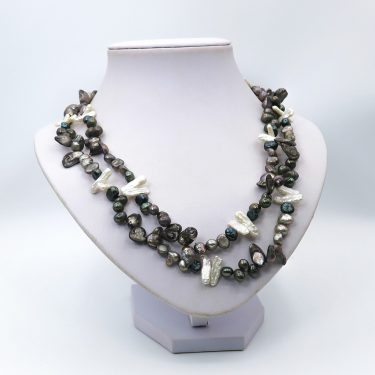
long black pearl necklace
€ 99.00
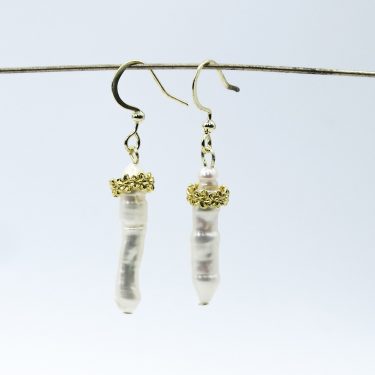
long pearl gold earrings
€ 44.00
Historical Saltwater Pearls
Akoya Pearls: Japan’s Elegant Legacy
Akoya pearls, small, round, and lustrous, are perhaps the most famous type of saltwater pearl. Cultivated primarily in Japan, they became popular in the late 19th and early 20th centuries and remain a symbol of timeless elegance. They were worn by European royals and American socialites alike, embodying grace and sophistication.
Japan has been cultivating Akoya pearls for over a century. Produced by the Pinctada martensii oyster, which inhabits saltwater regions around Japan, Akoya pearls are known for their perfectly round shape, brilliant luster, and rare pink overtones. The oysters are relatively small, about 8 cm (3.15 inches) wide, producing pearls that can reach up to 12 mm (0.47 inches) in diameter. Because of their consistent quality and beauty, Akoya pearls are among the most prized in the world.
South Sea Pearls: Imperial Grandeur
South Sea pearls, grown in oysters in the warm waters of Australia, Indonesia, and the Philippines, are larger and often white or golden. They were prized in the courts of Southeast Asia and by European monarchs, symbolizing wealth, purity, and prestige. Anecdotes tell of emperors and sultans commissioning custom necklaces of massive South Sea pearls, some weighing over 20 grams each.
Tahitian Pearls: The Mystique of the Pacific
Tahitian pearls, often dark and iridescent, have an aura of mystery and exoticism. Legends from the islands describe them as gifts from the sea goddess, believed to bring protection and luck. European explorers marveled at their beauty, and by the 20th century, Tahitian pearls were symbols of both natural wonder and luxury fashion.
Named after the island of Tahiti in French Polynesia, Tahitian pearls are cultivated in the Pinctada margaritifera oyster. These pearls are known for their stunning natural shades, silver-gray, blue-black, brown-black, and aubergine. These colors result from environmental factors such as water temperature, minerals, and plankton in the region.
Tahitian pearls are rare and valuable, known for their metallic sheen, smooth surface, and round shape. They take over six years to develop, and out of 2,000 oysters, only about ten yield pearls of gem-quality.
Snail Pearls
While pearls are most commonly formed in oysters and mussels, certain snails can also produce pearls, like the famous orange Melo Melo pearls. The Strombus gigas (queen conch) snail creates rare conch pearls, usually in shades of soft pink or lavender. These pearls are extremely rare; only one is found in every thousand snails. A flawless, smooth conch pearl is highly valuable; a necklace with matching earrings made of conch pearls once sold at auction for $178,500 (€160,352).
Blister and Mabé Pearls
Blister pearls and Mabé pearls are half-round pearls that form differently from traditional ones. Instead of developing inside the body of the mollusk, these pearls grow between the inner shell and the mollusk’s tissue. This results in a dome-shaped pearl with a flat back.
Blister pearls remain attached to the inner shell while they form. Once mature, they can be cut from the shell, usually with a thin layer of mother-of-pearl left behind as a base. The result is a pearl that appears set into a backing of nacre, making it ideal for certain types of jewelry.
In the 19th century, Japanese pearl farmers began cultivating these half-spherical pearls. Cultured versions of blister pearls are called Mabé pearls, named after the oyster species originally used for their production. Mabé pearls are especially valued for their smooth, domed appearance and are often used in earrings, rings, and pendants.
These pearls can be saltwater or freshwater pearls.

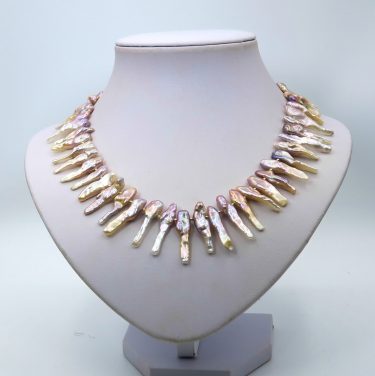
lilac pearl necklace
€ 235.00
pearl statement necklace
€ 330.00
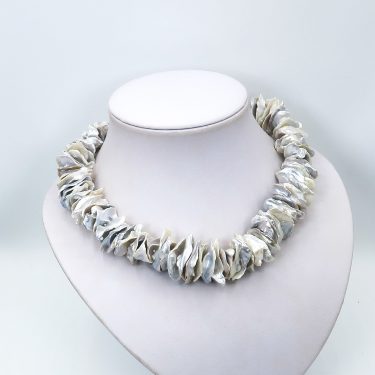
Shapes of Saltwater Pearls
Saltwater pearls generally favor round, near-round, and drop shapes, reflecting the influence of the nucleus.
Round Pearls
Perfectly round pearls are the most prized, often representing the pinnacle of craftsmanship and natural formation. Their symmetry and reflective luster make them ideal for classic necklaces and earrings.
Drop Pearls
Drop-shaped pearls are elegant and versatile, frequently used in pendants and chandelier earrings. Their natural form complements the human body’s curves, creating a graceful, flowing appearance.
Button Pearls
Button-shaped pearls are slightly flattened and often used in stud earrings. Their subtle shape provides visual interest while maintaining refinement.
Baroque Pearls
Though more commonly associated with freshwater pearls, baroque shapes also appear in saltwater varieties. Larger South Sea or Tahitian baroque pearls can become statement pieces in high jewelry, valued for their individuality and sculptural qualities.
Luster, Nacre, and Color
Saltwater pearls are famous for their high luster and reflective surfaces. The nacre layers are generally thinner than in freshwater pearls, but because the nucleus provides a firm base, the reflection is sharper and more mirror-like. Akoya pearls are celebrated for their bright, reflective shine, South Sea pearls for their soft, satiny glow, and Tahitian pearls for their deep, mysterious iridescence.
Color overtones play an important role. White, cream, gold, silver, black, green, and peacock hues add depth and character to each pearl. The combination of body color and overtone is often what determines a pearl’s market value.
Exceptional and Legendary Saltwater Pearls
Throughout history, certain saltwater pearls have become legendary. The La Peregrina pearl, found in the Gulf of Panama in the 16th century, became part of European royal jewelry collections, worn by Spanish queens and later by Elizabeth Taylor. Its perfect teardrop shape and history of imperial ownership cemented its status as one of the world’s most famous pearls.
The Hope Pearl, a massive South Sea pearl, is another example. Legends suggest it was once part of a sacred offering in India before becoming a collector’s treasure. Such stories highlight the cultural, historical, and symbolic weight that saltwater pearls carry across centuries.
Cleopatra’s Famous Bet
Pearls have fascinated people for centuries. In ancient times, they were rare and valuable, worn only by the elite. That’s why they’re often surrounded by myths, legends, and some jaw-dropping real stories.
One of the most famous involves Cleopatra, the legendary queen of Egypt, and her Roman lover, Marc Antony. As the story goes, first told by the Roman historian Pliny the Elder, Cleopatra boasted that she could host the most expensive dinner in history. Marc Antony took the bet.
When dinner began, he was unimpressed. The food was simple and cheap. But then Cleopatra made her move. She took one of her extravagant pearl earrings, worth millions in Roman currency, and dropped it into a cup of vinegar. After a short wait, she drank the mixture, pearl and all. Just like that, she won the bet.


Fact or Fiction?
Many believed the story was a myth until modern experiments proved it could be possible. Professor Prudence Jones of Montclair State University tested it with a 5-carat pearl and found that it dissolved in vinegar within 24 to 36 hours. The science? Calcium carbonate in the pearl reacts with acetic acid in the vinegar, forming calcium acetate, water, and carbon dioxide.
The ancients may not have had modern chemistry, but they certainly knew their pearls and how to make a statement with them. Therefore, an educated person like Cleopatra may have known this ‘trick’.
Could Cleopatra Dissolve a Pearl So Quickly?
It sounds unlikely, doesn’t it? The historian Pliny the Elder may have condensed the story for dramatic effect, but could such a large pearl dissolve faster than 24–36 hours?
Professor Prudence Jones put the legend to the test. She found that heating the vinegar lowers its water content, increasing the concentration of acetic acid and speeding up the reaction. To further accelerate the process, she crushed the pearl, a technique that drastically increases the surface area exposed to the vinegar.
And the result? In this concentrated, heated solution, the powdered pearl dissolved in just ten minutes.
So it turns out this long-told legend might actually be a historical fact—or at least, scientifically plausible!
The Value of Cleopatra’s Legendary Pearls
Cleopatra didn’t just use any pearl. According to Pliny, the two pearls in her earrings were the largest known pearls in the world at the time. He estimated their worth at an astonishing 60 million sestertii, equivalent to around $29 million today.
These weren’t just accessories; they were symbols of unmatched wealth and power.
Pliny wrote:
“The first place and the topmost rank among all things of price is held by pearls … Their whole value lies in their brilliance, size, roundness, smoothness, and weight … There have been two that were the largest in the whole of history; both were owned by Cleopatra … they had come down to her through the hands of the kings of the East.”
What Happened to the Other Pearl?
Since Cleopatra only used one pearl to win her bet, what became of the other?
According to Pliny, the remaining pearl was cut in half, a dramatic end for such a priceless gem. The two halves were then used to decorate the ears of the statue of Venus in Rome’s Pantheon. A fitting destination for a pearl once worn by a queen, now adorning a goddess.
The Pelegrina Pearl
Pearls don’t usually last forever. Their luster typically fades after about 100 years. High-quality natural pearls around 1 cm in diameter already command a steep price. But the Pelegrina pearl is no ordinary pearl. More than 500 years after its discovery, it still retains its original glow and quality, making it one of the most valuable pearls in history. At its last auction, it sold for nearly 11 million dollars.
Throughout the centuries, the Pelegrina has been worn by queens, kings, and other notable figures, appearing in many different settings. Its history is full of twists and turns, and for decades at a time, it seemed to vanish. Let’s take a closer look at this extraordinary pearl and why it has captured the admiration of so many powerful women.


The discovery in South America
The Pelegrina’s story begins in 1513 in the Gulf of Panama. According to legend, a slave discovered the pearl and was granted his freedom in return. It’s a touching tale, though historically inaccurate; slavery hadn’t yet been established in Panama at that time. What we do know is that the pearl eventually made its way to King Philip II of Spain, who ruled over Panama as part of the Spanish Empire.
Weighing nearly 56 carats (or 223.8 grains), the pearl is about the size and shape of a pigeon’s egg. Even back then, its value was estimated at $28,000, a staggering amount for the 16th century. Jewelers believe the real value was far higher, thanks to its extraordinary luster and size. The pearl became part of the Spanish Crown Jewels and was named “La Pelegrina,” meaning “the Pilgrim” or “the Wanderer.” This pearl should not be confused with the more famous “La Peregrina,” though the two are often mixed up due to the similar names.
A royal wedding gift
In 1554, King Philip II presented La Pelegrina to Queen Mary I of England as a wedding gift. She wore it as a pendant on a brooch, a symbol of status and wealth. When Queen Mary died in 1558, the pearl was returned to Spain in a diplomatic gesture of goodwill. It remained part of the Spanish Crown Jewels for the next 250 years.
In 1660, King Philip IV of Spain gave the pearl to his daughter, Maria Theresa, as a wedding present when she married Louis XIV of France. Before handing it over, he wore the pearl himself, mounted on his hat alongside a large table-cut diamond. After Maria Theresa’s death, the pearl likely became part of the French Crown Jewels, though its trail goes cold for a time.
Lost in revolution
The French Revolution in 1792 marked another turning point in the pearl’s journey. Many of the Crown Jewels, possibly including La Pelegrina, were looted by revolutionaries and sold off to foreign buyers. The pearl reappears in Russia, in the hands of the noble Yusupov family. A famous portrait of Zinaida Yusupova shows her wearing it as a pendant on a necklace.
In 1918, during the Russian Revolution, her son Felix Yusupov, best known for his role in the assassination of Rasputin, fled to Paris with a few of the family’s remaining jewels, including the Pelegrina. Life in exile was harsh. With little money to survive, Felix gradually sold off the treasures. In 1953, he parted with the Pelegrina, selling it to a jeweler in Geneva.

From Geneva to Hollywood
After Geneva, the pearl made its way to England and eventually ended up with the Hamilton family. In 1969, Richard Burton purchased the Pelegrina for $37,000 as a Valentine’s Day gift for Elizabeth Taylor. He bought it just in time; Spanish royalty had also been trying to reacquire it.
Taylor asked Cartier to design a necklace to showcase the pearl. The result was a lavish creation adorned with diamonds, rubies, and smaller pearls. She wore it often, including in several of her films.
But the pearl nearly disappeared once again. One day, Elizabeth Taylor noticed the necklace was missing. After searching the house, she discovered her dog happily chewing on something that wasn’t a toy or a bone, but the Pelegrina pearl itself. Fortunately, it survived the incident unscathed.
After Elizabeth Taylor’s death, the pearl was auctioned for nearly 12 million dollars, once again proving its place among the world’s most legendary gems.
You have to take care of your expensive pearls
In 1913, the pearl was cleaned and drilled. Before the cleaning, the weight is 223.8 grains / 11.2 grams. After the cleaning, there are only 203,84 grains left. Although the Pelegrina remains the largest pear-shaped pearl in the world, about 20 grains are gone. Part of the explanation can be the drilling, but that cannot be that much. There might be another cause…
In the time of Louis XIV, there were a lot of parties for the nobility. And taking a bath regularly was not a custom in those days. Everybody wears a wig, in the house and outside. To avoid the fleas coming into the wigs and your body odor getting too strong, people perfume and powder their wigs and use perfume on their clothing, body… well, about everywhere. Combine these facts with using candles at parties, and you can imagine the grease that sticks to the gemstones and pearls. That grease might even weigh about 20 grains.
Are there more exceptional examples?
Yes, there are, as the Pearl of Allah or the Pearl of Laozi. This one is about 24 cm / 9.45 inches big and weighs 6.4 kilos / 226 ounces. This is the biggest one in the world: it’s white but without any brilliance. A Filipino diver found this giant in the Sea of Palawan in the Philippines. This Tridacna Pearl is the product of a Baptismal Font Shell, i.e., Tridacna gigas. That is a large oyster, and the animal has a foreign object in the shell. The maximum age of the baptismal font shell is probably around a hundred years.
The ‘pearl of Allah’ looks like a head with a turban, and that turban has been associated with Mohammed and Allah. In 1966, a legend arose that in the gem there would be an amulet (already for thousands of years) with a verse from the Chinese philosopher Laozi. It was placed every time in a bigger shell so that it could grow. At the moment, an American family owns the Pearl, and now and then the gem is exhibited. The estimated value in 2007 was about 93 million dollars / € 83 million.
Exceptional 20th-century stories
In August 2015, a shell was found in the Oosterschelde (estuary between Belgium and the Netherlands) with 21 pearls. Normally, you can find at most 2 copies in a shell like that. The fisherman sold it to a fish store in the south of the Netherlands, and there they discovered an exceptional amount in only one shell. The shell was auctioned in the Hague/the Netherlands, for € 2600 / $ 2902.
Saltwater Pearls in Jewelry Design
Saltwater pearls have always been central to high jewelry design. Their smooth surfaces and reflective luster allow them to stand alone or complement gemstones. Designers often create uniform strands for classic elegance, but modern interpretations mix colors, sizes, and shapes to craft statement pieces.
Historically, saltwater pearls defined luxury. From tiaras at European courts to ceremonial necklaces in Asia, they communicated status and taste. Today, they continue to inspire designers who blend tradition with contemporary flair, integrating pearls into rings, necklaces, earrings, and even avant-garde creations.
Price and Value
Saltwater pearls are generally more expensive than freshwater pearls due to rarity, cultivation complexity, and historical prestige. Value is determined by size, luster, surface quality, shape, and color. South Sea and Tahitian pearls are particularly prized for their size and exotic colors, while Akoya pearls are valued for their perfection and reflective shine.
Investors and collectors alike recognize that the combination of rarity, beauty, and provenance makes saltwater pearls enduringly valuable.
Conclusion – Timeless Elegance
Saltwater pearls embody elegance, history, and artistry. Their smooth surfaces, reflective luster, and diverse forms connect wearers to centuries of cultural tradition, natural wonder, and human craftsmanship. From Akoya pearls adorning Japanese empresses to South Sea pearls celebrated in European courts, these pearls continue to inspire jewelry design worldwide.
Saltwater pearls demonstrate that beauty can be precise, radiant, and timeless. They are more than adornments—they are symbols of nature’s perfection, history’s legacy, and enduring elegance. Each pearl tells a story, inviting wearers to connect with centuries of artistry, tradition, and natural wonder.
Logically, a pearl is called a gem or even a gemstone. They are so ingeniously formed by such ‘clever’ animals, who give us such beautiful pieces of nature to make the most beautiful jewelry. For every budget and taste, there is a pearl. FlorenceJewelshop has made handmade, unique (no duplicates), and exclusive necklaces, earrings, and bracelets made of pearls. Just have a look.
I wrote a great and free e-book about pearls. You will find a lot of information there. It’s free, and just let me know where I can send it to.

"*" indicates required fields
Florence from FlorenceJewelshop