
 NL
NL
Although pearls are officially the birthstone of June (lucky you, June-born beauties!), I strongly believe the experts should reconsider and make them the birthstone of every month, every week, even every day. Pearls are simply too exceptional to be reserved for just one month. After all, pearls have a magical way of making every woman look stunning.
Alongside amber and coral, pearls are one of the only organic gems created by living creatures. Despite being formed by animals, they are rightly recognized by gemologists as genuine gemstones. But before you start keeping oysters as pets in hopes of creating your collection, know that it takes a perfect balance of conditions to form a pearl: clean water, ideal temperatures, the right species of mollusk, and a pristine, pesticide-free environment. It’s a miracle of nature that any pearls exist at all!
Introduction – Differences through Feeling and Wear Experience
Wearing a freshwater pearl is not about perfection, but about personality. These pearls rarely stand out because of absolute symmetry or sharp reflections. Instead, they show subtle differences in shape, gentle color gradients, and a warm, approachable presence. Freshwater pearls speak quietly, telling stories of time, growth, and nature rather than wealth or status. Unlike saltwater pearls, which have historically been associated with the aristocracy and luxury, freshwater pearls often have a personal, intimate feel. They are closer to everyday life, originating in rivers, lakes, and quiet ponds, and have long been treasured as symbols of protection, good fortune, and personal milestones.
Freshwater pearls are sometimes confused with cultured pearls, but this is a misconception. Cultivation refers to the process, not the type of pearl. Both freshwater and saltwater pearls can be cultured, but freshwater pearls retain a distinct character due to their environment, growth process, and natural variation. The experience of wearing freshwater pearls is therefore unique, offering a tactile connection to nature and history.
In this blog, we will explore the world of freshwater pearls, from their natural origins and historical legends to their diverse forms and contemporary use in jewelry design. Along the way, we will share anecdotes, cultural insights, and fascinating facts that reveal why freshwater pearls are cherished across centuries and continents.
What Are Freshwater Pearls
Freshwater pearls are formed in mussels living in rivers, lakes, and other freshwater habitats. Unlike saltwater pearls, they are not produced in oysters. Most of the freshwater pearls available today come from China, particularly from lakes in Jiangsu and Zhejiang provinces. Chinese pearl farming has a history of over a thousand years, and historical texts describe Buddhist monks inserting tiny statues or images into mussels to cultivate pearls that were revered not only for their beauty but also as sacred objects.
A single freshwater mussel can produce multiple pearls simultaneously, sometimes dozens. This makes freshwater pearls more accessible without diminishing their charm or authenticity. In 17th-century Europe, freshwater pearls were already appreciated by the elite for their organic shapes and soft colors. Unlike perfectly round saltwater pearls, freshwater pearls offered a natural, approachable beauty that lent itself to intimate personal adornment as well as public display.
Freshwater pearls come in a wide range of colors, from classic white and soft cream to delicate pinks, lavender, and subtle peach. These natural hues make them versatile and timeless, able to complement many styles and skin tones. The beauty of freshwater pearls lies not in strict uniformity but in subtle variation, giving each pearl a story and personality of its own.

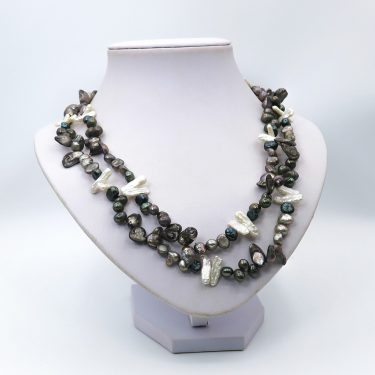
long black pearl necklace
€ 99.00
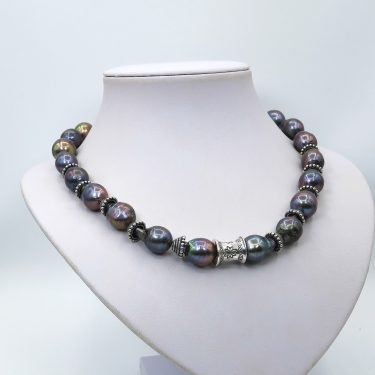
black baroque pearl necklace
€ 260.00
The Cultivation Process Without a Nucleus
Most freshwater pearls are cultured without a nucleus or bead. A small piece of mantle tissue from another mussel is inserted into the host mussel, stimulating it to secrete nacre layer by layer until a full pearl is formed. This results in pearls that are entirely made of nacre, giving them a soft, lustrous glow.
Because there is no rigid core, freshwater pearls develop in irregular and organic shapes, making each one unique. This technique, refined in Japan and China over centuries, allows for a wide variety of forms, from symmetrical ovals to baroque and Keshi pearls. During the Edo period, artisans in Japan were inspired by the natural shapes of freshwater pearls to create miniature jewelry pieces and decorative ornaments. The process produces pearls that are not just objects, but narratives of nature itself.
The absence of a nucleus also influences the feel of freshwater pearls. They have a natural weight and texture, which changes as they are worn over time. This makes them intimate, almost living accessories, unlike mass-produced beads or perfectly round saltwater pearls. The irregularity gives designers creative freedom, enabling them to tell stories through placement, combination, and composition in jewelry.
Historical Freshwater Pearls
Biwa Pearls: Reputation, Quality, and Influence
The Biwa Lakes in Japan were once famous for producing exceptional freshwater pearls. Biwa pearls often had elongated or flattened shapes and a lustrous surface that rivaled saltwater pearls. During the 19th century, they gained international fame, particularly in Europe and the United States, where they were used in luxurious necklaces, tiaras, and earrings. Court jewelers prized Biwa pearls for their unique forms and radiant glows.
One notable anecdote tells of a French countess who wore a Biwa pearl necklace to a grand ball at Versailles. Guests were enchanted not only by the pearls’ gentle shine but also by their irregular shapes, which stood out amid the rigid symmetry of traditional court jewelry. The countess’s choice demonstrated that natural variation could embody elegance and sophistication as much as uniformity.
Over time, environmental challenges and stricter regulations led to a sharp decline in Biwa pearl production. Today, the Biwa name is often used as a stylistic reference, but original Biwa pearls are rare. Their influence remains, however, shaping perceptions of freshwater pearls as objects of beauty, rarity, and character.
Transition to Modern Cultivation
In the 20th century, Chinese and Japanese pearl farmers advanced cultivation techniques, producing high-quality freshwater pearls that retained the charm of natural irregularity. Modern freshwater pearls are durable, lustrous, and available in a broad range of colors, sizes, and shapes. Despite technological advances, the legacy of traditional cultivation practices remains embedded in each pearl, connecting wearers to centuries of artisanal skill and cultural history.
Pearls for Emperors, Kings, and Pharaohs
Pearls have long been treasured, often exclusively by royalty.
Thousands of years ago, coastal people searching for food occasionally discovered oysters with pearls inside. These rare finds were immediately prized for their beauty. Archaeologists uncovered pearl jewelry in the tomb of a Persian princess dating back to around 400 BC, and ancient Chinese tomb paintings from the Tang Dynasty (circa 700 AD) depict elegant women adorned with pearls in their hair and around their necks.
Because of their rarity, large and high-quality pearls were considered treasures worthy only of emperors and kings. In ancient China, any fine pearl found was automatically claimed by the Emperor. Other monarchs followed suit, declaring pearls as “royal gems,” reserved exclusively for the elite.
What If There Were No Pearls Nearby?
Pearls weren’t native to Rome or Egypt, but that didn’t stop them from reaching Cleopatra’s court.
Arabian traders imported pearls from the Persian Gulf, the epicenter of the ancient pearl trade. They didn’t wait for oysters to wash ashore; they dove for them, collecting oysters directly from the sea. Occasionally, they uncovered extraordinary pearls with unusual colors or unique shapes, pearls fit for royalty.
These rare finds made their way across the desert, carried by camel caravans to the courts of kings and queens. And while everyday people may have admired them from afar, only the elite could afford to own these magnificent royal pearls.

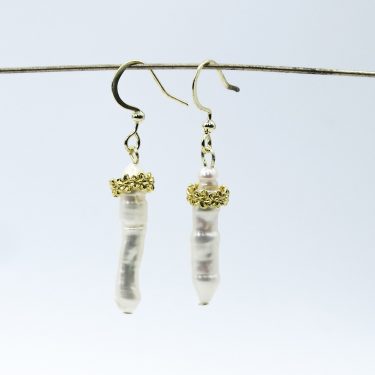
long pearl gold earrings
€ 44.00
Shapes of Freshwater Pearls
Freshwater pearls exist in an impressive array of shapes:
Round Pearls
Perfectly round freshwater pearls are rare and highly prized. They are often used in classic, minimalist jewelry designs where symmetry enhances elegance. Historically, round pearls were symbols of perfection and harmony, coveted by collectors and aristocrats alike.
Oval Pearls
Oval freshwater pearls combine elegance with versatility. They are ideal for pendants, earrings, and bracelets where an elongated shape adds fluidity and sophistication. Historical examples include Japanese court ornaments, where oval pearls were often set alongside gold filigree and delicate enamel.
Rice Pearls
Rice-shaped pearls are gently elongated and softly rounded. They provide rhythm and continuity in necklaces and bracelets. In historical Chinese jewelry, rice pearls symbolized harmony and continuity, often strung together in long strands for ceremonial occasions.
Potato Pearls
Potato-shaped pearls are irregular, plump, and organic. Their natural asymmetry adds charm and character to contemporary designs. In the European Baroque period, these pearls were celebrated for their distinctiveness and used in imaginative jewelry that played with natural forms.
Knot Pearls
Knot pearls are slightly pinched and almost hand-formed in appearance. They convey a playful, intimate feel, suitable for casual and artistic jewelry designs. Artisans in Japan and China have long valued these forms for their uniqueness and tactile qualities.
Blister and Mabé Pearls
Blister pearls and Mabé pearls are half-round pearls that form differently from traditional ones. Instead of developing inside the body of the mollusk, these pearls grow between the inner shell and the mollusk’s tissue. This results in a dome-shaped pearl with a flat back.
Blister pearls remain attached to the inner shell while they form. Once mature, they can be cut from the shell, usually with a thin layer of mother-of-pearl left behind as a base. The result is a pearl that appears set into a backing of nacre, making it ideal for certain types of jewelry.
In the 19th century, Japanese pearl farmers began cultivating these half-spherical pearls. Cultured versions of blister pearls are called Mabé pearls, named after the oyster species originally used for their production. Mabé pearls are especially valued for their smooth, domed appearance and are often used in earrings, rings, and pendants.
These pearls can be saltwater or freshwater pearls.


Keshi Pearls
Keshi pearls are byproducts of the cultivation process. They form without a nucleus and consist entirely of nacre, giving them exceptional luster and depth. Keshi pearls have been prized historically for their delicate shine and irregular, almost whimsical shapes, often appearing in religious ornaments, miniature sculptures, and heirloom jewelry.
The term “Keshi” was first used in Japan to describe pearls that formed without a nucleus.
A Keshi pearl forms when the oyster either rejects the implanted nucleus, but a piece of graft tissue remains, or when a small piece of that tissue detaches during the implantation process. These tissue cells form a pearl sac, and since there’s no core to shape the pearl around, the nacre builds up freely, resulting in irregular and organic shapes. Because they consist only of pure nacre, Keshi pearls are often more radiant than other cultured pearls.
Today, Keshi pearls are becoming rarer. Pearl farmers now closely monitor the oysters, and if the nucleus is lost or rejected, they typically reinsert a new one to ensure a standard cultured pearl develops.
Keshi pearls can grow in both saltwater and freshwater environments. The smallest varieties, typically around 1 mm (0.04 inches), come from the Akoya oyster. Larger Keshi pearls, ranging from 4 to 8 mm (0.15 to 0.30 inches), are found in South Sea and Tahitian oysters.
Their organic shapes and high luster make Keshi pearls a favorite among jewelry designers and collectors who appreciate natural beauty and uniqueness.
Baroque Pearls
Baroque freshwater pearls are defined by their asymmetry, twists, and protrusions. Historically considered inferior, they gained prominence during the European Renaissance. Jewelers used baroque pearls to create miniature sculptures of mythological and religious figures, turning irregularities into artistic statements.
Today, baroque pearls are celebrated for their individuality. Designers use them to craft jewelry that tells a story, emphasizing movement, texture, and character. Each baroque pearl becomes a small natural sculpture, giving jewelry a narrative quality.
Baroque pearls are making a major comeback! On the runways of Paris and Milan, bold, oversized statement jewelry is trending, and pearls are at the heart of it. One of my favorite materials for creating eye-catching necklaces or earrings this season? Baroque pearls.
These so-called “wild pearls” are cultured pearls with a nacre coating that grows around an irregularly shaped core. Because the nucleus isn’t perfectly round, the resulting pearl takes on unique, asymmetrical forms. That’s what gives baroque pearls their one-of-a-kind charm and character.
In many cases, freshwater cultured pearls qualify as baroque because they’re nucleated with mantle tissue instead of a solid bead. However, only the truly irregular ones earn the name “baroque”; the others, such as button, potato, or rice pearls, are named according to their more defined shapes. These are all technically variations of baroque-shaped pearls.
Baroque pearls also occur in saltwater environments. Cultured saltwater baroque pearls are often teardrop-shaped due to their spherical bead nuclei, but the nacre still forms in delightfully unpredictable ways.
So Many Shapes, So Many Stories
In pearl terminology, “baroque” simply refers to any pearl that isn’t perfectly round. These are more common than you might think, and come in all sizes, from minuscule to impressively large.
There are at least 12 commonly recognized types of baroque-shaped pearls, including blister, coin, rice, potato, Keshi, twin, cross, stick, and more. Each has its distinctive features. Of course, as with anything in nature, there are always exceptions. While most baroque pearls are freshwater cultured, saltwater varieties exist, too, including rare baroque-shaped Akoya pearls, which are typically known for their perfect roundness.
To keep things simple, in this blog, we’re focusing on the class of pearls that are non-spherical, roughly round or elongated, and marked by charming dips, ridges, and dents on the surface, true baroque beauties.

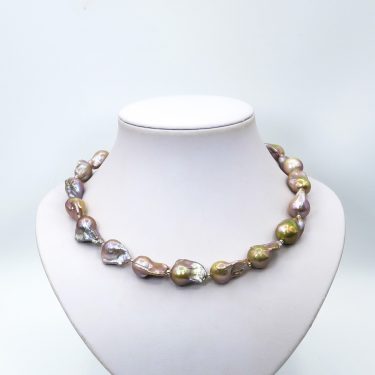
gold baroque pearl necklace
€ 272.00
Are Baroque Pearls Valuable?
They can be. The most valuable baroque pearls come from the South Sea and Tahitian oysters. These pearls take years to form thick nacre layers, and because they’re harvested less frequently, their rarity drives up the price. The longer it takes to cultivate, the more luminous and layered the nacre, and the higher the value.
But value isn’t only about rarity; it’s also about aesthetics and use. While an Akoya baroque pearl might be prized for its unusual shape, another misshapen pearl could be less expensive but breathtaking in the hands of the right designer. A skilled jeweler can transform irregular baroque shapes into showstopping pieces.
Shape also influences price. The most valuable baroque-shaped pearls include Keshi pearls, cross-shaped pearls, and classic baroque pearls. Large pearls typically command higher prices. On the other hand, smaller shapes like rice pearls tend to be less desirable to designers; they’re tricky to work with due to their size and tiny drill holes, and often priced accordingly.
Color matters, too. Baroque pearls in soft whites and pinks are priced moderately, but darker shades, especially those with deep luster and high reflectivity, can be exceptionally rare and expensive. A dark, high-shine baroque pearl is a true treasure.
Baroque Pearls Are Back in Style
When I traveled through Cambodia and Vietnam last January, I found something truly special on the very last day: two stunning strands of baroque pearls. One was a rich, dark gray, almost black, and the other a soft off-white. Under the light, the white pearls glowed with a subtle pink-to-purple sheen, while the dark pearls revealed hints of bronze and brown. Pure magic!
Luster, Nacre, and Durability
Freshwater pearls are distinguished by their soft, satin-like luster. Unlike the sharp reflections of saltwater pearls, the light disperses evenly across the surface, creating a warm, subtle glow. The thick nacre layers provide durability, making freshwater pearls suitable for jewelry worn daily.
Historically, freshwater pearls were used in everyday adornments by the Qing Dynasty elite in China and by European nobility. Their resilience and beauty allowed them to endure over generations, becoming cherished heirlooms.
The luster of a pearl depends on how light reflects and refracts through its transparent layers. The more layers there are, and the thinner they are, the finer the shine. Pearls are harvested either by divers or cultivated by pearl farmers. They are often round but can also take on irregular forms. Despite having a hardness of only 2.5 to 5 on the Mohs scale, pearls are surprisingly resilient and difficult to break. They can range in size from the tip of a needle to an extraordinary 24 centimeters (9.45 inches) in diameter, like the famed Pearl of Allah or the Hope Pearl.
Typically, a pearl will lose its nacre layer after about 100 to 105 years. However, archaeologists have discovered intact pearls in Pompeii, dating back to 79 AD. Humans have admired and used pearls for more than 6,000 years. Ancient Egyptians, including Cleopatra, wore them. Pearls have also been found in Mexico dating back to 2500 BC. In India, they were worn as amulets. The Mongols believed that boiling pearls in water gave them the power to strengthen men. In China, pearls were used as medicine, while in Rome, they symbolized luck, power, and wisdom.

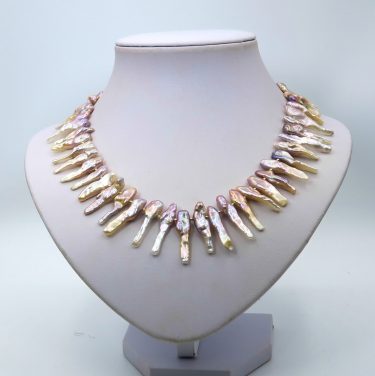
lilac pearl necklace
€ 235.00
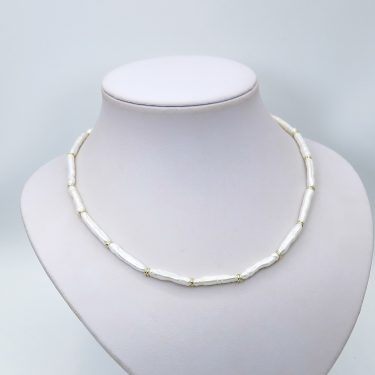
long pearl necklace
€ 60.00
Exceptional and Unique Pearls
Occasionally, freshwater pearls take on extraordinary shapes resembling animals, figures, or symbolic objects. One famous example is the reclining Buddha pearl discovered in 19th-century Japan, displayed in a temple for reverence rather than jewelry. These pearls were admired for their sculptural qualities and often became treasured collectibles, highlighting the intersection of natural artistry and human imagination.
Other legendary freshwater pearls were passed down through families as heirlooms, celebrated for their unique forms and personal significance. They underscore that freshwater pearls are more than jewelry—they are tangible stories of nature and culture.
Freshwater Pearls in Jewelry Design
Freshwater pearls offer designers immense freedom. Their variety in shape, size, and color allows each piece to be unique. Contemporary designers mix round, baroque, and Keshi pearls, often combining them with gemstones or recycled metals to create pieces that are both modern and rooted in tradition.
Historically, jewelry makers applied the same principles. In the palaces of Versailles or the Edo period courts, artisans combined different pearl shapes to achieve harmony, rhythm, and visual interest, transforming irregularity into artistry.
By the 18th and 19th centuries, pearls were no longer reserved for royalty. Wealthy members of the European bourgeoisie could now afford exquisite strands of pearls. Although still considered precious, pearls were becoming more accessible. A major turning point came in the early 20th century, when Japan and China entered the market with cultured pearls, revolutionizing the industry and making pearls more widely available than ever before.
Conclusion – Beauty Without Uniformity
Freshwater pearls demonstrate that beauty does not require perfection. Their charm lies in nuance, variation, and character. Each pearl is unique, carrying traces of its origin, growth, and history.
They invite the wearer to appreciate what is living, layered, and real. From historic Biwa pearls to contemporary jewelry, freshwater pearls connect story, tradition, and personal expression. They are more than adornments—they are natural art, living history, and intimate companions ready to be worn and cherished.
Freshwater pearls exemplify beauty through individuality, making them timeless treasures for both personal and cultural expression.
Logically, a pearl is called a gem or even a gemstone. They are so ingeniously formed by such ‘clever’ animals, who give us such beautiful pieces of nature to make the most beautiful jewelry. For every budget and taste, there is a pearl. FlorenceJewelshop has made handmade, unique (no duplicates), and exclusive necklaces, earrings, and bracelets made of pearls. Just have a look.
I wrote a great and free e-book about pearls. You will find a lot of information there. It’s free, and just let me know where I can send it to.

"*" indicates required fields
Florence from FlorenceJewelshop