
 NL
NL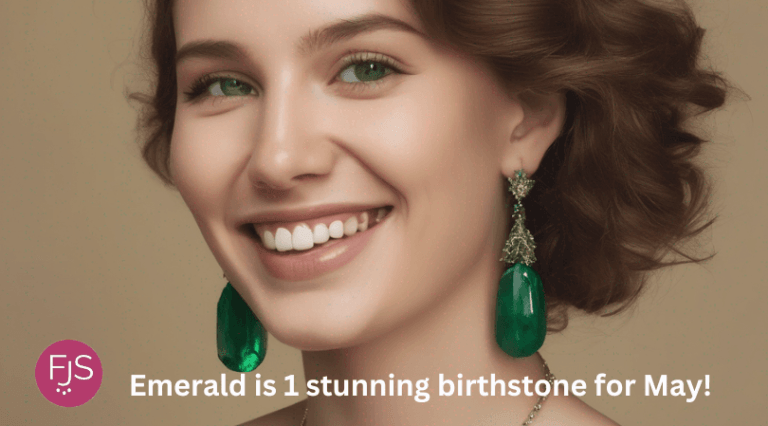
The lush green of spring meadows, the fresh leaves adorning trees in May, and the vibrant new plants emerging in your garden all mirror the captivating beauty of an emerald. That’s why the emerald is the perfect birthstone for May.

A Personal Story…
My father was a jeweler, working alongside his father and brother in their shop. One day, when there wasn’t enough money to pay his salary, he calculated what he was owed and, instead of taking cash, he chose an emerald necklace set in white gold.
My mother wasn’t exactly thrilled, after all, you can’t eat gemstones, but she couldn’t deny how much she loved the necklace. On her birthday, my father surprised her with a matching ring. From that day on, he began investing in gemstones as his kind of savings account.
Years later, when my father fell ill and the shop had to be sold, money trickled in slowly, too slowly. To get by, my parents parted with some of the jewelry they had collected over the years. But one piece was never up for sale: the emerald necklace my father had taken in place of his salary.
Emerald means ‘green,’ but to me, it means luck.
Two months before my wedding, my mother passed away. Before she left, she made me promise that the wedding would go on. It was difficult, but we carried on with the preparations. I chose my dress, my jewelry, everything.
Then, the night before the wedding, my brother arrived with something precious in his hands: my mother’s emerald necklace. He asked me to wear it, so a part of her could be there on my special day.
Even now, as I write this, my eyes fill with tears. Jewelry isn’t just an adornment; it’s emotion, memory, and love. And for me, this necklace will always be all of that and more.


The Four C’s
That necklace is more than just a piece of jewelry; it’s a symbol of our family’s resilience, a reminder that we can weather any storm. It also represents the value of a nest egg, a form of security that stands the test of time.
Emeralds, along with diamonds, sapphires, and rubies, are among the most precious gemstones in the world. Their value is determined by the Four C’s: color, cut, carat weight, and clarity. The intensity of the color, the precision of the cut, the weight in carats, and the stone’s clarity all play a role in defining its worth. A truly exceptional gemstone captivates not only with its beauty but also with the story it carries.

-
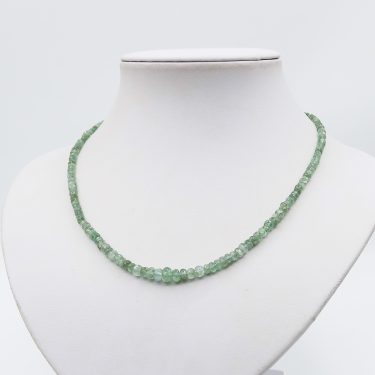
 green emerald necklace€ 142.00
The value.
Without an expert and the right tools, it is impossible to calculate the right value of your green treasure. Having said that! The color of this gem can range from light to deep green. The darker or deeper the green, the more valuable it is. When you don’t have too much money, you can purchase a very good emerald in a light green color. When you buy a light green copy, you ask the seller for a certificate so that you are certain you don’t buy beryl instead of a real emerald.
A great green color can be accomplished with a high-quality cut. The glance will be enlightened with high-quality facets of the cut. The shape is not important, but the quality of the cut is. The shape is a matter of taste, but the cut enlarges the quality and therefore the price.
A minimum of inclusions is needed
All the quartzes, like this green gem, have very small inclusions. They are important to know for sure that you don’t buy glass in the right color. But although the inclusions are not bad, the gemstone with fewer inclusions is more pricey than the one with a lot of inclusions. And a high-quality cut can leave as many inclusions out as possible. The hue and the saturation of the gemstone are the most important, and you can get that with a great cut, which minimizes the inclusions and enhances a beautiful color.
The last C is from ‘carat’, or size or weight. The larger the stone, the higher the price, when… (OK, you know this by now) The cut is fabulous, the color is stunning, and the clarity is great.


The crown of the Andes
Like every precious stone, emeralds have been used to create breathtaking pieces of jewelry and ornamentation. One of the most renowned examples is the legendary Crown of the Andes.
When Spanish conquerors arrived in the Americas, they unknowingly brought deadly diseases such as influenza and smallpox. The indigenous populations, having no immunity, suffered devastating losses. In 1590, a smallpox epidemic swept through the region, claiming countless lives.
In the city of Popayán, Colombia, fear gripped the people, and many sought refuge in the countryside. However, priests urged them to stay, encouraging them to pray to the Virgin Mary for protection. According to legend, their prayers were answered, smallpox never reached Popayán, and not a single person succumbed to the disease.
In gratitude, the priests proposed a grand gesture: a golden crown adorned with emeralds, crafted as an offering to the Virgin Mary. The people, surrounded by the region’s abundant gold and emeralds, eagerly contributed to the cause.
For six years, a team of 24 goldsmiths worked meticulously on the crown. The largest emerald said to have once belonged to the Inca Emperor Atahualpa was a remarkable 45 carats. Though its true origins remain uncertain, the crown was ultimately set with 450 of these green beauties, making it one of the most extraordinary religious artifacts of its time. Over the centuries, additional embellishments were added, further enhancing its grandeur.
The crown itself is a masterpiece: crafted from 18 to 22-carat gold, standing 34 centimeters (13 inches) tall, and weighing 2.17 kilos (4.8 lbs). The Atahualpa Emerald, the largest stone in the crown, measures 1.58 cm (0.62 inches) by 1.614 cm (0.635 inches).
In 1914, the Confraternity of the Immaculate Conception, which owned the crown, sought permission from the Pope to sell it, hoping to raise funds for charitable causes. Though permission was granted, no immediate buyers came forward. Finally, in 1936, an American syndicate acquired the crown, exhibiting it at various events, including a General Motors showcase for new Chevrolet models.
Today, this extraordinary piece of history is housed in the Metropolitan Museum of Art in New York, where visitors can admire its exquisite craftsmanship and storied past.


More amazing features of the emerald
1. The Origins
This striking green gemstone is a variety of the mineral beryl, which in its pure form is colorless. Beryl is the foundation of many gemstones, including aquamarine, heliodor, and morganite. Emeralds acquire their rich green hue when trace elements of chromium and vanadium interact with the otherwise colorless beryl, creating their signature vibrant color.
2. Ancient Egyptian Copies – Or Were They?
Although some of the oldest emeralds are estimated to be around three billion years old, the first known mines were in ancient Egypt, dating back to approximately 1500 BC. Cleopatra, renowned for her love of gemstones and lavish jewelry, personally owned all Egyptian emerald mines. Her palace was adorned with emerald-studded decorations, and she wore these precious gems extensively.
Egyptians believed that this green gemstone held great significance in the afterlife. Mummies were often buried with these gemstones, intended as payment for the ferryman to transport them across the river to the next world. However, modern archaeological and geological research has revealed a surprising truth: many of these so-called “emeralds” were peridots. While peridots are beautiful in their own right, they are not true emeralds. This misidentification persisted for centuries, even across Europe.
Genuine Egyptian copies can be distinguished by their slightly duller green hue compared to those from other regions. Today, this muted shade is less popular, as modern buyers tend to prefer more vivid pieces.
3. The Name Behind the Gem
The story behind the name emerald is a fascinating linguistic journey. It originates from the Greek word smaragdus, meaning “green gem.” In Dutch, the stone is called smaragd, but since Dutch was not a widely spoken language in Europe, it did not influence the gemstone’s global name. Latin speakers later adapted smaragdus into esmeraldus or esmeralda. The French refined this to esmeraude, which eventually evolved into the English word emerald.
This signature green color is believed to have a soothing effect on the eyes. Historically, gem cutters kept emeralds in their workspaces, using them to rest their eyes after long hours of detailed work. Staring at the gem’s calming hue was thought to alleviate strain and refresh their vision.
4. The World’s Most Beautiful Pieces
Colombia is home to the world’s most exquisite and sought-after emeralds, producing approximately 50% of the global supply. Among the most famous is the Gachalá Emerald, discovered in 1967 in the Vega de San Juan mine. This extraordinary gemstone is considered one of the most valuable emeralds ever found. To see this breathtaking piece of history, you’ll have to visit the Smithsonian Institution in the United States.


5. Inclusions: A Unique Feature, Not a Flaw
In most gemstones, inclusions lower the value, but emeralds are an exception. Every piece contains inclusions, yet rather than diminishing its worth, these internal features, known as jardin (French for “garden”), enhance its uniqueness. A highly saturated emerald, one with a deep, vibrant green, even with inclusions, is far more valuable than a pale, less saturated stone with fewer imperfections.
They have a hardness of 7.4 to 8 on the Mohs scale, meaning they resist scratches relatively well. However, despite this hardness, their internal inclusions make them more prone to breaking upon impact. While emeralds can be set in rings, they require protective settings to prevent damage, making them a less practical choice for everyday wear.
Color is the ultimate factor in determining an emerald’s value. The richer and more intense the green, the higher the price. To enhance their appearance, most of these gems undergo an oil treatment, which fills surface fractures and improves clarity.
If you were to find an emerald with perfect saturation and no inclusions, a rarity, you could command a price even higher than that of a top AAA-grade diamond of the same carat weight.
6. The Duke of Devonshire: A Giant Among Emeralds
In the world of record-breaking gemstones, the Duke of Devonshire stands out as one of the largest uncut emeralds ever discovered. Weighing just under 1,400 carats, this magnificent stone can be admired at the Natural History Museum in London.
Mined in Colombia in the 19th century, the mentioned piece was acquired by William Cavendish, the 6th Duke of Devonshire. While its exact history remains uncertain, one popular theory suggests that it was either gifted or sold to him by Emperor Dom Pedro I of Brazil in 1831.
7. The Timeless Allure
Emeralds have been cherished for thousands of years, perhaps even before Cleopatra’s time. In ancient civilizations, this mesmerizing green gem symbolized fertility and immortality. Cleopatra, who desperately needed either a son to inherit her throne or eternal life to prolong her reign, adorned herself and her palace with emeralds.
Foreign dignitaries visiting Egypt were often presented with emerald-encrusted gifts, a subtle yet powerful message from Cleopatra that she was the wealthiest and most influential woman on Earth. Sadly, the gemstone could not protect her from her fate; she died at the age of 39, whether by assassination or suicide remains a subject of historical debate.
In more recent history, another iconic woman brought emeralds back into the spotlight, Elizabeth Taylor, who famously wore them in her films. However, the modern resurgence of emerald fever can be credited to Angelina Jolie.
At the 2009 Academy Awards, Jolie walked the red carpet wearing a stunning pair of pear-shaped Colombian emerald earrings, designed by Lorraine Schwartz. The earrings, totaling 115 carats, were insured for a staggering $2.5 million. She also wore a matching ring weighing 65 carats, valued at $1 million. This single appearance reignited global interest in this gem’s jewelry, solidifying the gem’s status as a symbol of elegance and luxury.


8. The Mysterious “Emerald” Buddha
Within the sacred Wat Phra Kaew temple, located on the grounds of the Grand Palace in Bangkok, Thailand, sits the revered Emerald Buddha. Despite its name, this statue is not made of this green gemstone but is carved from jade or possibly jasper.
Its true material remains unverified, as the statue is considered so sacred that no one dares—or is permitted—to examine it closely. To believers, its holiness is unquestionable, and for them, the idea that it might be anything other than emerald is simply irrelevant.
9. The Mystical Powers
Emeralds have long been believed to enhance clairvoyance. According to legend, placing an emerald under your tongue could grant you the ability to foresee the future. Some also believe that wearing or holding an emerald compels people to speak the truth—an ability that law enforcement might find useful, though they have yet to incorporate emeralds into their investigations!
Additionally, these green beauties are thought to support memory retention. It is said that elderly individuals who wear this gem jewelry may experience a reduced risk of memory loss. No scientific guarantees, of course—but if it works, it might be worth a try!
10. A Stone of Wealth, Power, and Healing
Throughout history, emeralds have been regarded as powerful talismans. Ancient civilizations believed that wearing an emerald could bring wealth, power, and eloquence. More intriguingly, this vibrant green gemstone was also thought to have the ability to predict the future.
Doctors in Arabia, India, and Spain once used these green gems as remedies for infections, dysentery, and even poisoning. Meanwhile, spiritual healers and priests employed the gem in exorcisms, believing it could help drive out demons from those who were thought to be possessed.
If you’re lucky enough to be born in May—the month of emeralds—and receive a genuine piece as a birthday gift, consider yourself truly fortunate! And if that gift happens to be one of my necklaces or another piece of emerald jewelry… well, you’re even luckier.
If you’re the lucky lady born in May and receive a genuine piece of jewelry for your birthday, please don’t tell me. I might be too jealous to even congratulate you!
Just kidding… But if you do happen to get my emerald necklace—or any other piece of jewelry for your birthday—I’d love to send you my free e-book. It’s packed with fascinating details about emeralds and all the other birthstones. Just let me know where to send it!

"*" indicates required fields
Florence from FlorenceJewelshop