
 NL
NL
You might wonder how on earth it is possible that 1 amber necklace makes me, or maybe your life, a lot better. That improvement is caused by two things, and I hope that after reading this blog post, at least one piece of this gem’s jewelry is added to your wish list.

Last year, I spent some days in Warsaw/Poland. The amber beads that I bought in the Baltic States were finished, and I was keen on buying some new ones. But that was a real challenge. Because it is expensive, very expensive. The bigger the beads and the rounder the beads, the higher the price.
I saw a necklace of rather big, round orange beads in a window, and the price tag said they cost € 7000 / $8100. They were polished orange round beads and gorgeous, but too expensive for me. Then I was lucky… in a very small shop, with an old, nice lady behind the counter, I found great and affordable beads. And a great story.


Great features
Looking around, I told the lady that I was a jewelry designer and was looking for beads, not necessarily complete strings. Then out of the blue, she asked me, ‘Do you have headaches and stomach pains?’ At that moment, I felt a severe headache coming on and wanted to go back to the hotel. It was like she felt or saw that I was in a bit of pain.
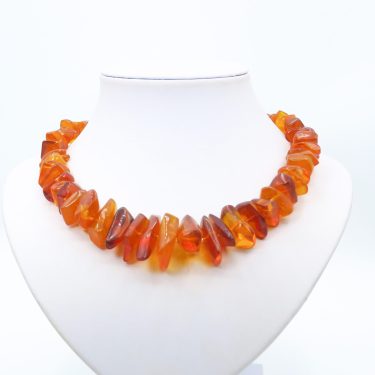
She gave me some raw or rough, anyway, not polished amber in a beautiful orange color. She said that this unpolished one is used by the Vikings as a remedy against headaches and stomach pains. No need to say that I bought a string from her, and also some polished strings.
-
 orange statement necklace€ 165.00

Also, at this time, this gem is regarded as a healing stone to chase away all negativity from your body; it stimulates good humor and prevents depression.
Say, you love rather large necklaces and earrings, but you have trouble with your neck or shoulders. I would advise you to wear this gem. It is very light, and even when the beads are larger, you hardly feel the necklace around your neck. And you look awesome.
Say, you feel bad, and you don’t know where it comes from. All that negative energy wears you out, and you keep feeling depressed. Wear non-polished copies that attract positive energy, and you will feel better. And even when it does not work straight away, with this gem, you look better!


Every season brings new colors to the new fashion and jewelry collections. One of the trendy colors is brown-shaded orange. This color will match beautifully with dark blue (Goldstone, lapis lazuli), brown (tiger eye), or even black (lava stone, onyx). Amber can vary from yellow to orange, reddish, and brown. However, green, blue, and even black varieties also occur. And different colors make a gorgeous piece of jewelry.
Although many combinations of color and material are beautiful, I would suggest combining faceted or shiny gemstones with non-polished amber. When you want to have a necklace or earrings of polished beads, the combination with a matte or rougher surface gemstone looks stunning.
And remember: the round, transparent, more yellowish beads, preferably with little insects in them, are the most expensive.
To summarize all the great features of this natural gemstone:
- It is very light and easy to wear
- Wearing non-polished amber will give you positive energy
- Unpolished beads can help avoid migraines, headaches, and stomach problems
Besides all these great things, amber is just unique and beautiful.


This gem turns up in my life again
Last November, I retired from my daytime job. I was happy to have more time to spend on my jewelry business. But I also wanted to do something for our local community. For a few years, we have had a museum dedicated to the archaeological finds in our neighborhood.
When constructors started to build houses quite near where I live, they discovered a very, very old wooden boat that looked like a canoe, and the remains of a very ancient young girl. The local government decided to bring the girl to life again by using the remains to rebuild her body and face. And we call her ‘Hilde’.
It is fascinating to see how Hilde comes alive; she looks like a ‘normal’ girl, wearing clothes from those times, but also with the jewelry of those times. They found a necklace with amber beads near her body, and that necklace is around her neck in the museum.
And next month or so, I start as a guide in that museum. And as preparation, the first thing I did was check where that necklace comes from.


I know Amber, I know that you can find it of that quality only in the Baltic States, and that is about 1500 kilometers or 932 miles away (overland, it’s more when you travel overseas). How did it get from the Baltic Sea to a small village in the Netherlands? Around the neck of Hilda?
The magic word of the solution is ‘trade’. Those people traveled in their wooden open canoes up to the Baltic States, sold their stuff, and got amber in return. The Vikings were masters in carving these gem pieces into animal shapes or beads.
Already in the Middle Ages, this gem was very popular as a decoration and a piece of jewelry. But even in those days, you had to be rich to afford such a precious piece of jewelry.
What is it, and why is it so precious?
Around 60-40 million years ago, Scandinavia and the Baltic States were covered with pine trees (Pinus succinifera). When a tree gets damaged, it repairs that damage by producing resin. Resin is rather sticky, and insects, leaves, and plants can get caught in that resin.
When the resin drips on the ground and the oxygen is cut off from the resin, that sticky stuff will fossilize. After a few thousand years of fossilization, there are still oils in the resin. That material is called Copal, and when even the oils are gone (a few thousand years after that), it becomes amber. The possible inclusions, like insects, plants, or leaves, will turn blackish (no colors left).
It is flooded away
About 35 million years ago, the level of the sea started rising, and the amber was flushed away from the Scandinavian soil by the rivers. Later (15 million years), the gem was flushed even further, and you can still find beautiful pieces on the coasts of the Baltic States and Denmark.
And turns up further down in Europe
The Vikings recognized the beauty and the value of this gem and started trading with it. We can find amber jewelry in graves not only in Scandinavia but also in the Middle East. There were trade routes that brought it from the north of Europe to the countries in the South of Europe and even further.
The most beautiful thing about it is that you can see the insects and plants from millions and millions of years ago in those beautiful pieces. Even the softer parts are visible, which is not the case when you find fossilized dinosaurs, etc. Amber with inclusion is like a time capsule, where time stopped a few million years ago.


What does it look like?
The fresh resin, when it drops from a tree, is yellow, and most of the gum has that color. And every piece started its life being yellow. Because the resin is sticky at the beginning, it can pick up all kinds of insects, plants, or other stuff, which can change the color into brown or orange-red, but also green, blue, or black. The transparent yellow pieces are most popular, and when there is an insect or plant in that piece, the amber will get quite valuable.
It is a soft ‘stone’ (2-2.5 on the scale of Mohs). Together with pearls and coral, it belongs to the few organic semi-precious stones. Since it consists of organic material, it can burn.
It has power!
When you rub a piece along an animal’s skin, or past wool or silk, the amber piece will become electrically charged, and you can pick up a little piece of paper with it. People did not know what electricity was at that time, though it was very powerful and magical.
For that reason, this gem was for many tribes in the past a spiritual stone with its soul. For instance, the gladiators in the Roman Empire wore a piece of it when they had to fight in the arena. And the Celtic sun god was called ‘Ambres’.

False ones and copies
When a gemstone is precious and beautiful, and the demand is higher than the supply, there are always people who try to copy that gemstone. The same happens with amber. One uses copal (the younger amber of about 1000-1 million years old), glass, synthetic resin, or just plastic to copy amber. The good thing is that I will give you some tips to recognize the real amber.
Tips to recognize the false amber copies:
- Amber can burn, but to try this method, you can damage the gem, although a really old piece will likely not melt, but get more uneven. You can heat a needle with a lighter and pinch with the hot needle in the whole of an amber bead to avoid damaging the amber. When you smell a pine odor with a little burned touch, it is amber, when you smell sweet resin, it is copal, and when you smell plastic, well… it is plastic.
- When the copy is made of glass, it feels colder than the real amber, and it is harder (cannot be scratched by metal).
- When you see a piece of amber with inclusions of scorpions or other tropical insects, it is fake. Scorpions did not occur at that time in the Baltic States. When you only see one inclusion in the stone, be careful: mostly, there are a few (parts of) insects in one piece of amber.
- If you have time, you can mix 2 cups of water with 1 cup of salt. Stir until the salt is dissolved. Amber, but also the copal will float, and the rest will go down.
- Amber is not smooth, but a little uneven, and it has cracks on the surface.
- Put a drop of acetone on the amber and leave it there for 2-3 seconds. Wipe it away after that time. Amber will not be damaged by the acetone, and all the other materials will.
- Rub the amber against wool or silk, and it will be statically loaded. You can pick up little pieces of tissue now. That will be amber.
No doubt you will love wearing amber, whether it is a necklace or earrings, you will feel and look great with it. I love wearing amber because it is warm (it adapts quite fast to my body temperature) and it is light.
A lady wants to look awesome, with the right outfit and matching jewelry. But it is not always so easy to find out what color outfit matches what kind of gemstone jewelry. To help you out, I developed a color chart. Per color, you find the matching gemstones, which are practical since a lot of gemstones occur in different colors.
Interested? Well, you are lucky since the gemstone color chart is free of charge! Just let me know to whom I can send it. And an extra tip: when you give a loved one a piece of jewelry, you might add this free gemstone color chart to the present. Just a little extra from me.

"*" indicates required fields
Florence from FlorenceJewelshop
Enjoy your knowledge and stories !!
Thank you Kathy!