
 NL
NL
The origin of jewelry is a story as timeless as humanity itself. It is filled with creativity, beauty, and the desire to express identity. From the very beginning, people have felt the need to adorn themselves, to stand out, and to communicate something deeper through what they wear. Jewelry tells the story of our past, our beliefs, and our dreams.
As a voluntary guide in the provincial archaeological museum in my hometown, I see that fascination every day. When visitors look at the prehistoric jewelry in the glass cases, their first reaction is almost always the same. “These are so beautiful, how could people make this thousands of years ago?” It is a wonderful question. People in those times may not have been able to read or write, but they had skill, patience, and a deep artistic sense. They used the materials around them to create something that still moves us today.
Maybe you would react the same way. That is why I want to share the amazing story of the origin of jewelry, which started more than 100,000 years ago and continues to evolve even now.


Knowing the Origin of Jewelry Is Important
The origin of jewelry is not just about decoration. It is a mirror of human history. From the earliest times, people used jewelry to show who they were and what they valued. The materials and techniques changed through the centuries, but the symbolic power of jewelry remained. Jewelry has always represented beauty, status, protection, and love.
By studying the origin of jewelry, we learn how people lived, what they feared, and what they believed in. Jewelry reveals ancient customs, social structures, and even technological progress. The development of tools, trade routes, and cultural exchange can all be traced through the jewelry people left behind.
Jewelry is more than an accessory. It is art. It is communication without words. It is a direct connection to our ancestors and the world they lived in. When you hold an ancient bead or pendant, you are holding a piece of human history.
When Did the Origin of Jewelry Begin?
If we go back in time, we discover that the origin of jewelry began with the first humans who stood upright. Even before people used clothes or made tools, they wore jewelry. Around 100,000 years ago, people started decorating themselves with natural materials such as shells, bones, feathers, wood, and colorful pebbles. These early pieces were simple, but they already carried meaning.
The origin of jewelry was tied to nature. People used what they could find nearby. They drilled holes into shells, tied feathers into their hair, and strung pebbles into necklaces. When they discovered how to work with metal, jewelry became more durable and refined. But the purpose stayed the same—to create beauty, to show belonging, and to express individuality.


Why Humans Wear Jewelry?
The reasons why people wear jewelry have always been emotional, practical, and symbolic. From the origin of jewelry, people have used it to show their place in the community. Jewelry could mark belonging to a tribe or family, or express personal identity. It could also be a symbol of affection, power, or spiritual belief.
In early societies, jewelry showed strength and courage. A hunter who provided food for his tribe might wear a necklace made from the teeth or claws of the animals he killed. This not only displayed his skill but was believed to bring luck for future hunts. Jewelry became part of human psychology. It gave confidence, pride, and a sense of security.
People also used jewelry to protect themselves from the unknown forces of nature. They believed that stones, bones, and shells had magic powers. Amulets made from these materials were thought to protect against illness, storms, and bad luck. This belief in the healing and protective qualities of gemstones continues to this day.
There was also a practical side. Jewelry had value. It could be traded or sold in difficult times. That is why women often received jewelry as part of their dowry. In times of war or exile, people sewed jewelry into their clothing to carry their wealth safely. History remembers the Russian Tsar family doing exactly that during the revolution. Jewelry has always been both an emotional and a financial security.
-
 red coral necklace€ 210.00

-
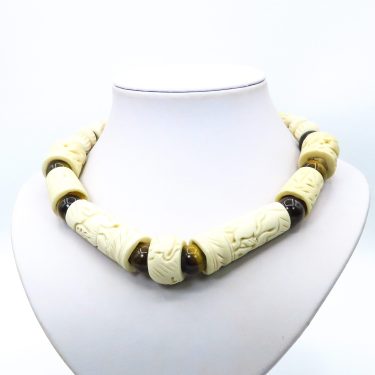
white bone gem necklace€ 112.00
Symbols and Meanings in the Origin of Jewelry
Throughout the origin of jewelry, certain symbols appear again and again. Crowns, rings, and pendants have always represented power, love, and loyalty. Expensive jewelry has been a sign of wealth since ancient times. A crown meant kingship, a jeweled dagger showed leadership, and a wedding ring marked commitment.
But jewelry has always meant more to women. From the earliest times, women wore jewelry to express beauty, confidence, and individuality. The right piece of jewelry could make a woman feel special, admired, and strong. That emotional connection to jewelry has never changed.
The origin of jewelry also tells us about social hierarchy. In ancient times, slaves sometimes had to wear bracelets engraved with their owner’s name. In medieval Europe, only nobles and high-ranking priests were allowed to wear gemstones. Religious jewelry has also played an important role. Crosses, prayer beads, and other symbols appear in nearly every culture. The way they are worn can reveal someone’s faith, such as Catholic couples wearing rings on the left hand and Protestant couples on the right.


Jewelry can even reshape the human body. The “long-neck” women of the Kayan tribe in Thailand wear copper rings from childhood, adding more each year. The stretched neck has become their symbol of beauty. In southern Ethiopia, members of the Suri tribe wear large lip plates. For the men, it symbolizes bravery. For the women, it is said to prevent kidnapping by enemies and sometimes symbolizes fertility. Every piece of jewelry tells a story of identity, tradition, and belief.
The Practical Side of Early Jewelry
The origin of jewelry was not only about beauty. As human life changed, jewelry became practical. When people began to settle and farm along riverbanks, they discovered metals and gemstones in the soil. They learned to craft more complex designs and used jewelry to decorate every part of the body.
The head had tiaras, crowns, earrings, and hair combs. The neck and chest displayed necklaces, brooches, and belts. Arms and hands wore bracelets, rings, and armlets. Ankles and feet had anklets and toe rings. Every part of the body was seen as a place for adornment.
Jewelry also had a practical use. Brooches and fibulae fastened cloaks and garments. Pins held the fabric in place. These early designs combined beauty with functionality.


The First Jewelry Discoveries
Archaeological finds give us a window into the origin of jewelry. The Old Stone Age, which lasted until about 10,000 years ago, gives us the earliest examples. People used natural materials, many of which decayed, so we only find the pieces made of bone, shell, or stone.
In Doggerland, a prehistoric area now under the North Sea, tiny bird bone beads were found. They date back over 130,000 years and show that even the earliest humans made jewelry. In my hometown of Velsen, eight beads made from human shinbones were discovered, dating from 2000 to 1800 BC. The people who wore them likely believed these beads offered protection or strength.
In Morocco’s Bizmoune Cave, archaeologists found 33 shell beads made by the Aterian people about 142,000 years ago. They still carry traces of red ochre, proving they were painted for decoration. In Malta, one of Europe’s oldest civilizations made jewelry from fish bones and shells as early as 4000 BC.
In Croatia, 130,000-year-old eagle talons were found, probably used as a necklace by Neanderthals. Ostrich eggshell jewelry has been found in Spain, and marble rings discovered in Kenya and Russia date back 42,000 years. Each discovery adds another piece to the story of the origin of jewelry.


As soon as people began to work with metals and gemstones, jewelry became easier to preserve. When they started burying their dead with precious objects, archaeologists found a treasure trove of information about ancient cultures and their beliefs.


The Age of Metals and Gemstones
When humans discovered how to work with metals like gold, silver, and copper, the origin of jewelry entered a new chapter. The invention of bronze, made from copper and tin, allowed for even more refined craftsmanship.
Jewelry making became a profession. Not everyone could shape metal or set gemstones. Skilled artisans appeared, designing jewelry for kings, queens, and priests. The purpose of jewelry remained the same: to convey status, beauty, and protection, but the designs became increasingly intricate.
Grave Discoveries and What They Reveal
Much of what we know about the origin of jewelry comes from archaeological excavations. One of the most important discoveries was the Royal Tombs of Sumer in modern-day Iraq, dating back to around 3000 BC.
In Mesopotamia, archaeologists found jewelry made of gold, silver, and gemstones like lapis lazuli and carnelian. Amulets and seals often depicted stars and flowers, symbolizing divinity and life. Jewelry was also used as an offering to the gods or to decorate statues in temples.
The most famous find was the tomb of Queen Puabi. Her entire body was adorned with jewelry, including necklaces, bracelets, crowns, and more. Her robe was made of gold and precious stones, and her headdress was adorned with golden flowers. This single discovery taught us more about ancient craftsmanship and culture than any text from the same era.


Tutankhamun and the Golden Age of Jewelry
In 1922, Howard Carter discovered the tomb of the young Pharaoh Tutankhamun in Egypt’s Valley of the Kings. This discovery changed everything we knew about the origin of jewelry in ancient Egypt.
Inside the tomb were thousands of treasures, including the famous golden death mask. The jewelry found there was breathtaking: necklaces, bracelets, rings, and diadems, all perfectly preserved. The craftsmanship was so advanced that even modern jewelers admire it.
Tutankhamun’s jewelry revealed the deep symbolic meaning the Egyptians gave to their adornments. Scarabs represented transformation and rebirth. The ankh symbolized life. Egyptians loved colorful gemstones like lapis lazuli, carnelian, and turquoise, arranged in multi-strand necklaces. Many of these stones were imported from distant lands, proving that international trade existed thousands of years ago.
They also mastered a technique called faience, a type of glazed material that imitated precious stones. Gold and yellow represented the sun, while green stones symbolized new life. A green stone was often placed in a mummy’s mouth so the spirit could speak in the afterlife.


The Never-Ending Journey of Jewelry
The origin of jewelry is far from over. Its story continues through every civilization, every style, and every artist who creates something new. Early jewelry and its development can be divided into three great civilizations: Egypt and Mesopotamia, India, and China. Each added its own symbols, techniques, and materials to the evolution of jewelry.
Jewelry remains an art form that connects the past and the present. It shows us where humanity began and where it is going. It reminds us that beauty, identity, and emotion are eternal.
At FlorenceJewelshop, this connection between history and modern design is what inspires me most. I create unique and exclusive jewelry made from gemstones and silver that I find during my travels. Each bead has its own story, and every design is made only once. My jewelry is designed for the modern woman, but with influences from ancient cultures that shaped the origin of jewelry itself.
It is important to me that you not only wear jewelry but also understand it. I want you to feel inspired and informed, to wear jewelry that makes you look beautiful, feel confident, and express your unique personality.
To help with that, FlorenceJewelshop has created a free PDF guide filled with tips on how to highlight your best features by choosing the right jewelry for you. It is my gift to you. Just let me know where to send it, and I will share it with pleasure.
The origin of jewelry is not just a story from the past. It is a story that continues every time someone puts on a necklace, a pair of earrings, or a simple ring. It is the story of who we are, where we came from, and the beauty we continue to create.

"*" indicates required fields
Florence from FlorenceJewelshop