
 NL
NL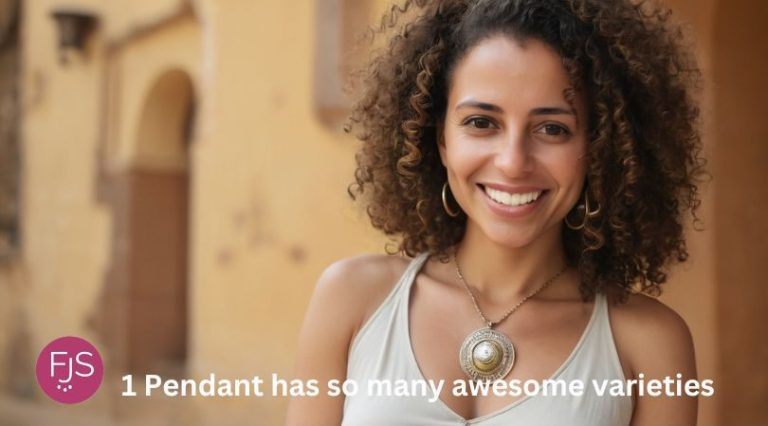
Since mankind invented the necklace, they have tried to make it more beautiful. Every new necklace or necklace design needed something extra to make yourself more beautiful and to stand out in the crowd. The simpler and therefore powerful way to do that is to add a pendant, a charm, or a pomander to that piece of jewelry.
Even today, people wear add-ons to their jewelry, like getting an inscribed charm for their bracelet on a special occasion, or adding a stunning pendant to their (maybe dull) necklace to make it look better. And what about a locker or a medallion? A few ages back, in the period when taking a bath every day was not considered useful, people wore pomanders to take away the smell.
Let us dive into the world of jewelry add-ons.
The pendant
Pendant necklaces are ‘as old as the way to Methusalem’ is an old Dutch expression when someone wants to explain that some item or trend is very, very old. And the use of pendants is very old, as old as the Stone Age, as far as we know. Archaeologists discovered pendants in old graves, and they state that people wore Pendants to make themselves more beautiful and powerful!’
The pendant necklace is derived from the habit of wearing amulets or talismans on a string around the neck. The idea was that those amulets could chase the evil spirits away. But also, the shamans wore pendants or amulets on a string to show everybody that they had the wisdom and, therefore, power. Don’t fuss around with them, or the amulet/pendant will make you be punished.


In the period when someone invented a chain, which you can hang something on, like a pendant, pendant necklaces became fashionable. From the grave finds, we know that the ancient Egyptians, people from Mesopotamia (a country between the Euphrates and the Tigris), the Greeks, and the Romans liked to wear charms or small pendants around their necks. They thought it would protect them from evil. A great example is the Eye of Horus, which was popular in Egypt.
Pendants through the ages
The pendants in the Stone Age were made of shells, bones, feathers, and stones. Ages later, the Egyptian Pharaohs wore pendants in the shape of the gods, like Horus (eye or falcon), Atom (snake), or the sacred scarab. In Egypt, these kinds of pendants were the symbol of power and showed the people that the Pharaoh was the god on earth, sent by the god in heaven.
Also, the kings/emperors of Greece and Rome used the pendant for those reasons. In the Middle Ages, the meaning and the look of the pendant changed a bit. In those days, the most important jewelry was religion-based. The pendants were holders of relics, adorned with precious stones. The common shape was a cross. The pendants and their necklaces were a statement of someone’s wealth and status.
-
 rose quartz pendant necklace€ 55.00


The pendants in ‘modern times.’
Starting from the 16th century, the importance of the pendant changed again; it became a decoration rather than a religious object. Although many pendants were very rich with gemstones and precious metals, decorated with crosses.
In the early 17th century (before 1630), pendants were not that popular. Wearing a ‘molensteenkraag’ or a ‘millstone collar’ was in fashion, and that item did not leave much room for a pendant. Those collars were made of 10 to 15 meters of lace, pleated together into a collar. The Spanish people brought this fashion to the Netherlands, and a collar like that gave a lot of status.
Pendants and pendant necklaces never were completely out of style, but as a rule, you might say that wearing pendants or not following the fashion of the clothing of the ladies. When the collars lowered, the pendants were popular, and if the fashion dictated high collars, you did not see that many pendants anymore.
The popularity of the pendant went up and down over time, and this year the pendant is ‘up’. At the fashion shows and in the collection of jewelry designers, you see a lot of pendants on long necklaces. Sometimes the pendant is somewhere below the middle of a model.
Now you know where the pendant comes from, it is time to look at the use of the pendant with your outfit. I want to give you some tips so that you know how to wear a necklace with a pendant and how to look beautiful with one.
-
rose quartz pendant necklace€ 55.00
-
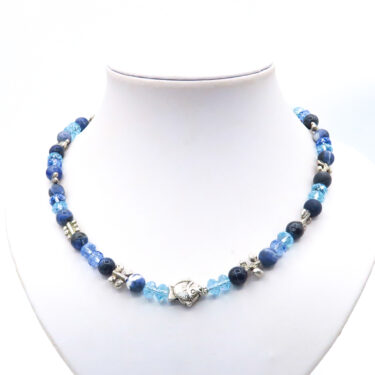
blue quartz necklace€ 90.00
My tips:
- A long necklace with a pendant makes you look longer. The pendant points down and makes a kind of vertical line from your body. When you are small, by all means, wear as many pendants as you like and fancy. But when you are a tall lady, be careful with this trendy piece of jewelry. When you want to wear a necklace with a pendant, and you are tall, choose a choker with a pendant or a somewhat shorter necklace. Otherwise, you look even taller than you already are.
- Don’t wear a necklace with a pendant when you have a large bosom (or wear the pendant on a choker, to get the views to your neck instead of lower down). When you do, the result is that the pendant hangs under your bosom in the free space. And that doesn’t look great. It accentuates the large bosom, and maybe that is not what you want. Avoid the pendant slipping into your cleavage. Everybody will look at your bosom to see where the pendant got stuck (OK, maybe exaggerated, but still)


Ladies with small bosoms look gorgeous with a long necklace and pendant, especially when they are smaller. Ladies with a large bosom should better wear a choker with a pendant (when they want to be one), and then the shorter the pendant, the better. That is when you have a long neck; otherwise, you look choked with a choker.
The conclusion is that smaller ladies with small bosoms will look stunning with a longer necklace and pendant. The ladies with other features should be careful when wearing them. To be more precise, when you have a larger bosom, and you want to wear a pendant or a pendant necklace, make sure that the chain or the necklace is somewhat shorter.
Pendants and charms are beautiful when attached to a necklace. But do you know when you can wear a pendant necklace best and what a pendant necklace does for your ‘look’? FlorenceJewelshop published a small e-book with all the information and tips you need to look awesome with a necklace or a pendant necklace. It is free of charge! Just let me know to whom I can send it.

"*" indicates required fields
The pomander, the pendant with a lovely smell
In times of infectious diseases, people invent all types of ways to keep the disease far from them. For a long time, sick people have worn herbs with them to keep the illness away. No idea whether that treatment helps, but men and women like the smell. Especially in the days when a bath was a great event that was practiced not too often.
But to carry around a full bag of herbs around your waist is not practical. And after the invention of perfume, the pomander, a jewel with a perfect smell, became popular.
Probably the idea of using herbs to keep bad smells away and for ‘perfuming’ death originates from Egypt. The herbs are also used to incense the gods and in religious gatherings. It is the Greeks who started to use herbs such as frankincense and myrrh for taking a bath and perfuming their body (daily use). The frankincense and myrrh are stored in small bottles, called ‘aryballos’.
In the first century BC, glass-blowing was invented in Syria. And not long after that, the ‘herb bottles’ are made of glass. The herb bottle in those days could be more valuable than pieces of jewelry.
The Phoenicians are the traders in the Mediterranean Sea area, and their ships transport herb bottles in different shapes and materials. The bottle is so popular that every area has its own shape.

The Arabs invented a perfume
Up to the 12th century, nothing changed in the perfume industry, which was an ‘herb’ industry. People can make a kind of oil out of herbs, but it is not the liquid perfume as we know it today.
But then… the Arabs invented the technique of distillation. Not only herbs but also flowers, smelling leaves, amber, ailment, and musk are boiled, distilled, and end up as a perfumed type of oil (still solid).
People think that this perfumed oil has therapeutic powers and is the remedy to keep pestilence and other pandemic illnesses away. It is a multi-functional remedy since they think that perfume enlarges the male potential and strengthens female organs.
As easy as the herbs can be carried along in a bag around your waist, the perfumed oil has to be stored in some way.
Just as before the 12th century, when all types and shapes of aryballos were available. And now, every perfume maker designs a perfume and a matching bottle. In those days, perfume makers and jewelry makers sat together and came up with an ideal storage product: the pomander.

What is a pomander?
In the early Middle Ages, a pomander was a silver bowl with a lot of small parts with holes in them. Every part contains another perfumed oil or spice, and the smell spreads around. To make it more practical, the bowl is attached to a beautiful chain, like a necklace.
A pomander is initially a French word. It means ‘pomme d’amber’ or apple of amber.
In the second part of the 13th century, perfumed oil got a liquid sister. The perfume or ‘cologne’ is made of alcohol and essential oils. And is stored in all types and shapes of perfume bottles made of glass and crystal. Initially, the pomander is of no use anymore since the liquid will flow away through the holes.

After the 16th century, it became fashionable to wear wigs. The system of running hot water has not been invented yet. Taking a bath is not a daily practice. And let’s be honest: people just smell without a bath. And with wigs, where fleas are jumping from one wig to another. You may not have a great smell, but even then…
The pomander starts with a popularity battle. The bowl loses its parts and becomes a ball with two parts. It looks like a small, beautifully decorated silver container on a necklace or in the shape of a ring. In the ball, you put a small piece of cotton or cedarwood. And every time you feel like you spray a little bit of perfume on the cotton or wood. The smell comes through the small holes of the ball, and your clothing, hair, and skin smell delicious.

Maybe it is just a coincidence, but nowadays I see more and more pomanders on the market. I don’t think it is a good idea to use it as a prevention against COVID-19. But it cannot be bad to wear a beautiful necklace with a smelling pendant.
And if a pendant is not the thing for you, another way to get a nice smell around you is incense sticks. Just like they did in the old days, or in the yoga studios. And the perfume dot behind your ear is also a way to spread a nice smell.
Would you wear a pomander, a necklace that smells delicious? Maybe not a 4711 smell, but roses or jasmine? I think I would, but not too much. Another thing is would you wear a necklace that is a bit longer? You don’t wear a pomander close to your face, but as a pendant on a longer chain.
A pomander on a longer chain is excellent for the shorter ladies because with a vertical line, you look longer. The ladies with a somewhat larger bosom have to take care that the pomander does not fall into the cleavage, but more down.
The charm
Everybody knows that things from our youth that disappeared will come back one day or another. Sometimes modernized. But the same thing may be ‘reinvented’ again and become fashionable. When I was about 5 years old, I got my parents a bracelet for my birthday. My grandparents gave me a ‘lucky’ charm for it. And on every suitable occasion, my bracelet grew.
But my eyes grew wide when I saw the trend, new, and hot jewelry designs of this year… charms, and more. You might say that a charming charm is a joy forever, and one charm will never die.
The funny thing about collecting them for my bracelet was that you could choose an applicable jewel for the situation. I had a hockey stick charm when I tried to master that sport, and a new doggie meant a new ‘dog’ charm. I forgot why I had a ‘teapot’, but it was lovely.
While preparing a blog about these lovely pieces of jewelry, I discovered that a bracelet like this was not invented in my youth. Back then, it was also a reinvention from an earlier period.


When was the beginning of this trend?
Probably wearing charms on bracelets or necklaces started as a form of talisman or amulet, to get rid of bad luck or evil spirits and ghosts. In prehistoric times, they were made of shells, clay, or bones. Archaeologists found them in Africa that are more than 75.000 years old. In Germany, one was cut from a mammoth tusk of 30.000 years old. And even in Egypt, they have found some that were used for luck and identification.
In the Roman Times, charms in the shape of little fish were used as identification by Christians. And Jewish scholars were able to write parts of the Jewish law on a charm to keep it close to their hearts. I have found so many examples of times when they were popular, and in every other period, the popularity of these jewels went down and up again. Like it is a joy forever. You might forget it for ages, but it always comes back.
They were mostly worn on necklaces or fabric and leather strings. Bracelets with them came up in the time of the Assyrians and the Persians, around 600 to 400 BC. A very big fan of wearing bracelets with these jewels was Queen Victoria. She was a kind of trendsetter for the European nobility at that time.


Not only necklaces, but also charm bracelets!
Queen Victoria loved charm bracelets, and her family and friends received many beautiful and precious ones on several occasions from her. When her husband, Prince Albert, died, she ordered a jewelry designer to make a ‘mourning one’ with a lock of hair from the prince. It became a big trend.
A trend that was picked up very fast by the commercial parties. For instance, Tiffany introduced 1889 their first charm bracelet in, with a little heart. In the 20s and 30s of the last century, during the Great Depression, golden and diamond copies were manufactured. And in the 50s and 60s, teenagers collected them, which were a memory of an important event in their lives. And now we are back to my youth again, when I got my first charm bracelet. It’s like a ring that turns and turns, and every spot of the ring comes forward in due time.
And what about the Pandora trend with their bracelet and beads? Remember my words… they keep coming back!

My silver ‘dubbeltjes’ bracelet
When I was young, I got at special days, like birthdays, a charm on my bracelet. I had even three of them. On one bracelet, I collected charms depicting the country or city I had visited. On the other hand, there were silver coins with inscriptions, like ‘going to college’ or ‘my first communion’, with on the other end the date.
But my favorite was the bracelet with the dubbeltjes. A dubbeltje is the most beautiful coin in the whole world, and even non-Dutch people admit that. The value was 10 cents and was used before the coming of the Euro, in the Netherlands. One of the dubbeltjes had the image of Queen Wilhelmina and dated from 1953, my year of birth.
And the other ones were for every year of my life. My father made from each dubbeltje a charm for my bracelet. There were so many that it was dangerous to wear the bracelet since I was hooking everywhere. On my 21st birthday, my father made the bracelet, like you, so in the picture (above this part).
To be honest, I had no idea where it was until my husband urged me to organize my working space. And there it was, my very loved, but a bit lost bracelet with the dubbeltjes. By the way, at the same time, I found the other two bracelets, with all the charms still on them.
Conclusion: Don’t follow the Marie Kondo trend
So the conclusion might be that you should keep your jewelry at all times since it will become popular again. Therefore, I looked for my charm bracelet everywhere, but I could not find it. So when I want to participate in this ‘new trend’, I have to buy another one and start collecting the ones that represent great events in my life. I might do that, since when this trend goes down, I just have to wait until some designer decides that it is time to dust the old ones again and make it a trend.
Bracelets are popular and not without reason. They look gorgeous, and with charms, they are tinkling so nicely. But do you know what type of bracelet looks best with your arms, short or long? If you have large hips, is it wise to wear bracelets? All those questions and the answers are in the e-book FlorenceJewelshop published. It is free of charge. Just let me know to whom I can send it….. And… please let me know whether you have found your charm bracelet from your youth.

"*" indicates required fields
Hug Florence from FlorenceJewelshop.